How Many Spare Rechargeable Table Lamps Should a Restaurant Order?
A buyer-focused method for separating ready complete lamps, charging rotation, replacement parts and controlled reserve stock before an RFQ or bulk order.
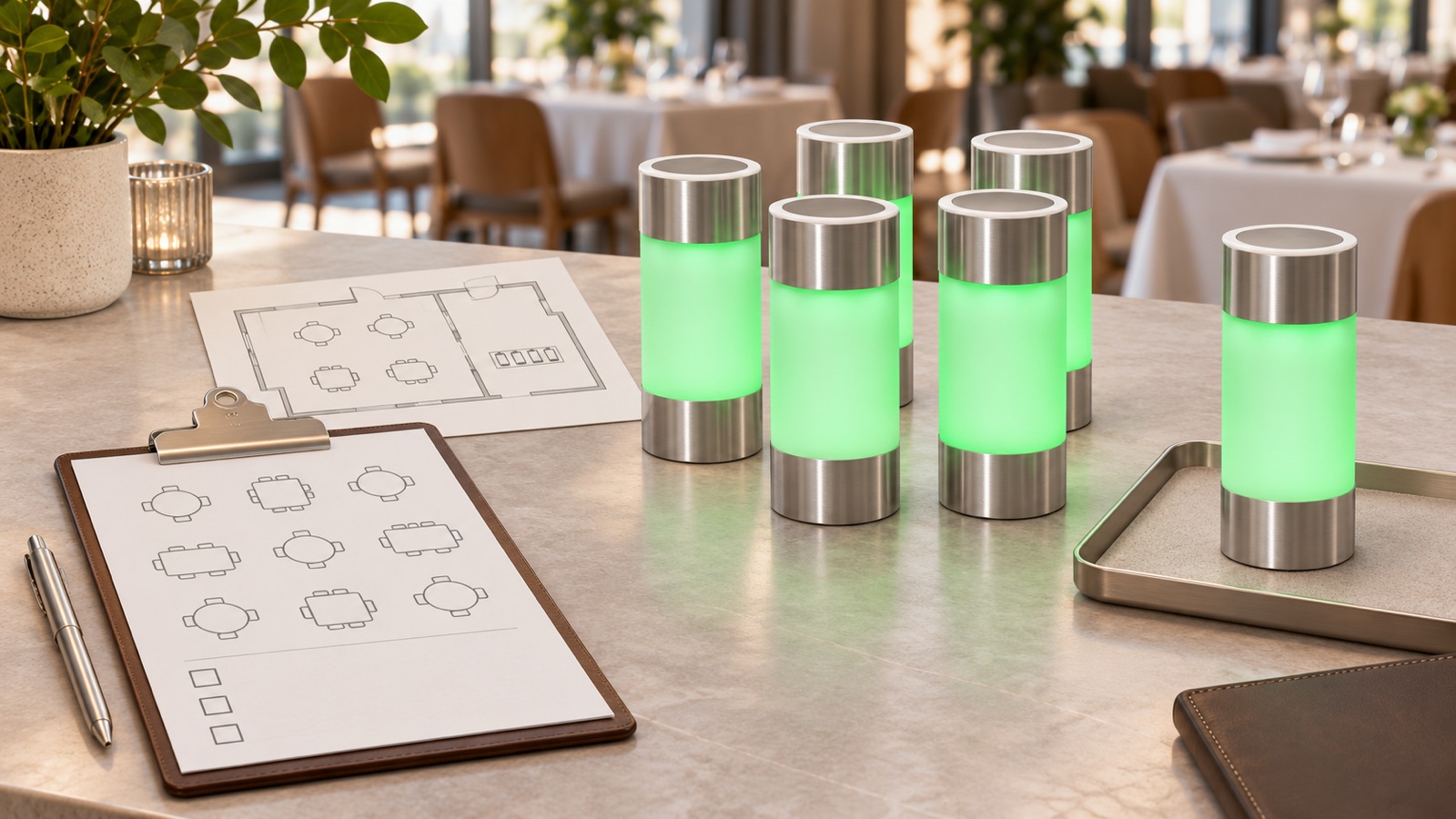
A restaurant should not choose spare rechargeable table lamps from a universal percentage alone. Start with the maximum number of lamps required on the floor, then add the highest number likely to be unavailable at the same time because of charging, cleaning, inspection, damage isolation, private events or approved repair. Keep those causes separate, because a lamp that is charging creates a different requirement from a lamp awaiting a part or supplier decision.
For a new venue with no operating history, use a documented planning estimate and review it after the pilot. For an existing venue, use several weeks of shift records. The result should be a count of commissioned, ready-to-use lamps, not an arbitrary carton quantity.
This guide explains how to set an opening reserve, choose complete lamps or replacement accessories, and write the requirement into an RFQ. No reserve percentage fits every restaurant.
The short answer: calculate simultaneous unavailability
The key question is not “What percentage should we add?” It is “How many lamps could be unavailable at the same time while the venue still needs its full table-lighting plan?”
Use this planning structure:
Opening lamp quantity = maximum deployed positions + operating reserve + controlled project reserve
The maximum deployed positions are the lamps needed across every area that may operate at the same time. The operating reserve covers predictable temporary gaps during normal service. The controlled project reserve covers approved needs such as an opening event, a private-dining reset or a small number of units held for evaluation.
Do not add every estimate automatically. Record overlaps and assumptions so procurement, operations and the supplier can challenge them before ordering.
Why “one lamp per table plus 10%” can be misleading
A percentage is easy to quote but can hide the workflow. It can mean different things:
- extra lamps stored fully charged and ready to deploy;
- lamps rotating through charging while service continues;
- unpacked replacement stock that has not been commissioned;
- units reserved for another zone or event;
- defective units awaiting inspection;
- spare batteries, adapters or bases rather than complete lamps.
Those categories are not interchangeable. A boxed lamp may need inspection and charging. An adapter cannot replace a damaged lamp body. A lamp assigned to the rooftop may not be available to the main room during the same service.
A percentage can be a final sense-check, but the purchasing decision should come from counted operating conditions.
Step 1: count the maximum deployed lamp positions
Create a zone-by-zone table instead of using the total number of dining tables from a floor plan.
| Operating zone | Maximum lamps in service | Same-time condition | Notes to confirm |
|---|---|---|---|
| Main dining room | Buyer count | Normal peak service | One or more lamps per table based on the approved layout |
| Bar and lounge | Buyer count | Open with main dining | Include counter positions and loose seating |
| Private dining | Buyer count | Event booking overlaps normal service | Confirm whether lamps are shared or dedicated |
| Covered terrace | Buyer count | Seasonal or weather-dependent | Use only a model approved for the actual exposure |
| Host, service or display points | Buyer count | Venue-specific | Do not include decorative positions that will never operate |
Count the highest credible simultaneous setup, not the sum of every possible layout. If a private room uses lamps moved from a closed lunch zone, document that sharing. If all areas can operate together, count them together.
Large communal tables may need a different arrangement from two-person tables. The pilot should confirm the number and placement rather than assuming one lamp per table. Use the restaurant menu-light evaluation guide to check the real table setting and ambient light before freezing the quantity.
Step 2: identify temporary unavailability during service
Separate each cause of temporary unavailability and estimate the highest same-time count.
Charging rotation
If every lamp is fully charged before service and the verified runtime covers the operating window, the opening reserve may not need to cover routine mid-service charging. If the venue runs consecutive services, uses several brightness settings or has a shorter charging window, a rotation group may be necessary.
Do not infer runtime from battery capacity. For JBTD-137, the published product data states 2600 mAh battery capacity and 0.6 W rated lamp power, but it does not establish a verified runtime or charging duration. Test samples under the planned setting and service schedule. The battery runtime testing guide explains how to record a repeatable sample test.
Cleaning and inspection hold
An inspection can remove a lamp from the floor because of a loose component, visible damage, contamination or an unusual charging observation. The reserve should let staff isolate it instead of returning it without a decision.
The reserve is not a reason to skip investigation. Tag the lamp, record its identifier and keep it outside the ready area until the responsible person clears it. Link the workflow to the commercial lamp cleaning and maintenance guide.
Accidental damage or missing units
Lamps move during resets, events and closing. A unit may be damaged, misplaced or sent to the wrong zone. Use a labeled opening assumption, then replace it with the highest credible same-time count from the log.
Event and layout changeover
A banquet layout, terrace opening or temporary bar extension may need extra lamps. Recurring requirements belong in the maximum deployed count. Occasional controlled requirements may sit in the project reserve.
Step 3: separate ready spares from parts and accessories
A complete commissioned lamp can replace a unit at the table. Parts and accessories support different tasks. State what is required and whether the supplier has confirmed it for the exact model.
| Reserve item | What it can cover | What must be confirmed |
|---|---|---|
| Complete commissioned lamp | Immediate table replacement | Same model, finish, light behavior, identification and charging compatibility |
| Matching charging position | Additional charging capacity | Exact base or rack, supported positions, adapter and plug |
| Adapter or power cord | Damaged or misplaced power component | Exact electrical rating, connector and destination plug |
| Replaceable external part | Cosmetic or mechanical service | Part number, replacement method, tools and effect on warranty |
| Battery or internal module | Battery-related service only if supported | Whether field replacement is permitted, exact pack, procedure, safety and documentation |
| Packaging insert or protective sleeve | Storage or return transport | Fit, labeling and handling method |
Do not describe a battery, LED module, end cap or charging contact as user-replaceable unless the supplier has provided model-specific instructions. The public JBTD-137 information reviewed for this guide does not establish a field-replaceable battery, spare-parts list, repair procedure or warranty condition. Request those items in writing before building them into the operating plan.
Use the commercial table lamp TCO guide to keep replacement assumptions separate from verified supplier terms.
Step 4: check charging capacity for the full ready fleet
The charging plan must support the lamps that return to the charging area. Active lamps plus ready spares do not automatically equal simultaneous charging positions; the schedule must show when each group charges and becomes available.
For JBTD-137, published values identify 12 V DC / 0.3 A input per lamp and a specified 12 V DC / 10 A / 120 W adapter for a matching shared configuration of up to 25 lamps. “Up to 25” applies only to that matching configuration. It is not permission to connect any 25 lamps to any rack, adapter or power supply.
Map three moments:
- the highest number returned after a service;
- the number of matched charging positions available then;
- the time by which each lamp group must be ready again.
If spares remain in storage for long periods, ask the supplier for model-specific storage and recharge instructions. Do not assume that leaving every spare continuously connected is correct. The multi-lamp charging capacity guide covers position planning in more detail.
Step 5: build an opening estimate without pretending it is history
For a new venue, label the calculation as an assumption-based opening plan. The following is a hypothetical example, not a recommendation for every restaurant.
Hypothetical example
A venue plans a maximum of 48 lamps in the main room, eight at the bar and four in a private room that can operate at the same time. Its maximum deployed count is therefore 60.
During the pilot, the team wants to test the following planning conditions:
- two lamps held ready for an unexpected table or zone change;
- two lamps available while questionable units are isolated for inspection;
- one lamp for a controlled event setup that does not overlap the second zone-change allowance;
- no routine charging rotation because the sample test must first confirm whether all deployed lamps can complete the planned service.
The team records an opening target of 65 complete commissioned lamps: 60 deployed plus five ready units. It does not call five a universal reserve percentage. It also lists charging positions, adapters and any separately confirmed accessories on their own lines.
If the runtime pilot later shows that a charged rotation group is needed, the buyer updates the plan before the bulk order. If operating records show that only one lamp is usually unavailable, the venue can reduce future reserve purchases or reassign stock. If several units wait for supplier decisions at the same time, the service and parts plan needs attention rather than a permanently larger unexplained reserve.
Step 6: turn the estimate into a shift-level control
A reserve only works if staff can find, identify and deploy it. Create a simple status system:
- Ready: inspected, charged according to the approved process and available for service.
- In service: assigned to a defined zone.
- Charging: in the matched charging area with a planned ready time.
- Hold: isolated for cleaning, inspection or a supplier decision.
- Event allocation: reserved for a named setup and return time.
Use durable identifiers if appropriate for the venue. The record can be a small spreadsheet, clipboard or asset system. It should show counts by status, not personal data. At closing, reconcile the number returned, charging, held and missing.
Avoid mixing ready stock with uninspected cartons. Factory testing and shipment inspection may support acceptance, but the venue should still complete its own arrival check and commissioning record. Verify carton count, visible condition, correct model and finish, included components, destination plug and charging compatibility against the purchase order. Do not claim that a shipment inspection occurred unless the actual inspection record exists.
Step 7: review the reserve after real service data exists
After the opening period or pilot, track:
- maximum lamps deployed at once;
- highest simultaneous charging count during an operating window;
- highest same-time inspection hold;
- missing or damaged units by cause;
- event demand that exceeded the base layout;
- time from hold decision to return, replacement or closure;
- occasions when no ready spare was available;
- unused ready spares that never entered rotation.
The objective is to make the reason for each unit visible. Ready spares support continuity; uncommissioned excess stock creates capital and storage work.
What to request from the supplier
Add a reserve and service section to the RFQ and request model-specific answers.
- exact model and revision for the active and spare lamps;
- confirmation that finish, light behavior and charging interface match;
- bill of materials for lamps, bases, racks, adapters, cords and destination plugs;
- identification of any components that are consumable or replaceable;
- part numbers and compatibility boundaries;
- written instructions for storage, charging, cleaning and fault isolation.
- price and minimum quantity for complete spare lamps;
- price and minimum quantity for confirmed replacement accessories;
- how replacement orders are identified against the original project;
- packaging and labeling for reserve stock;
- lead time and warranty only as stated in the final supplier quotation;
- process for photos, serial or batch identification and issue review.
- sample approval record for the exact configuration;
- factory testing items that will be documented for the order;
- shipment inspection scope, if purchased or agreed;
- arrival inspection checklist;
- acceptance method for appearance, switching behavior and matched charging equipment;
- responsible contact for unresolved units.
Use the commercial rechargeable table lamp RFQ checklist to combine these points with destination, packaging and documentation requirements.
Procurement checklist
Before approving the bulk order, confirm:
- [ ] maximum simultaneous lamp positions by operating zone;
- [ ] sample-tested service and charging workflow;
- [ ] counted reasons for temporary unavailability;
- [ ] documented opening reserve assumption;
- [ ] distinction between complete ready lamps and parts;
- [ ] exact matched charging components and quantities;
- [ ] storage, identification and status method;
- [ ] arrival and shipment-inspection responsibilities;
- [ ] supplier process for held or replacement units;
- [ ] review date for replacing assumptions with operating data.
FAQ
What is a normal spare-lamp percentage for a restaurant?
There is no universal percentage. Calculate maximum deployment and credible simultaneous unavailability from charging, inspection, damage isolation and events. Use a percentage only as a final comparison.
Should spare lamps be kept boxed or charged?
Commission and identify units intended for immediate service. Separate long-term stock from the ready reserve and follow model-specific storage guidance.
Are spare batteries better than spare complete lamps?
They solve different problems. A complete lamp replaces a unit at the table. A battery helps only if the exact pack, permitted procedure, controls and post-repair test are defined. Do not assume this for JBTD-137 without evidence.
How many JBTD-137 lamps can use one shared charging setup?
The published figure is up to 25 lamps only with the matching shared JBTD-137 configuration and specified 12 V DC / 10 A / 120 W adapter. Confirm the exact rack or base, adapter, cords, plug and supported positions in the quotation.
Does 2600 mAh tell me how many spare lamps I need?
No. It is a battery-capacity value, not a verified runtime or shift-coverage result. Test the sample under the planned brightness, service duration and charging workflow.
When should the reserve quantity be reviewed?
Review it after the pilot or opening period and whenever the table layout, service schedule, event program, charging system or supplier configuration changes. Use actual same-time unavailability rather than a lifetime average alone.
Should a distributor use the same reserve method as a restaurant?
Not exactly. A distributor may need service stock for several customers, destination-specific versions and replacement-order lead times. A restaurant mainly needs venue continuity. Both should separate commissioned complete lamps from parts and unverified stock.
Conclusion
The right spare-lamp quantity is a counted operating decision. Start with maximum simultaneous deployment. Add the number of complete lamps needed to cover credible same-time charging, inspection, damage isolation and event requirements. Keep parts, chargers and boxed inventory on separate lines. Then replace opening assumptions with pilot and shift data.
For JBTD-137, use the verified model values to identify the proposed lamp and matching shared charging configuration. Do not turn battery capacity, adapter rating or the up-to-25 condition into an unsupported runtime, repairability or reserve claim.
Send your requirements to Jbian.
Ask Jbian for an itemized lamp, charging and reserve quotation. Send your venue layout, maximum active lamp count, service schedule, event use, destination, plug requirement and opening-reserve assumptions. Jbian can identify the proposed JBTD-137 configuration, included components and the questions that still require sample or supplier confirmation.