How to Clean Commercial Rechargeable Table Lamps
A practical buyer guide to supplier care documents, approved wipe-down trials, cleaning and charging workflows, and staff checklists for restaurant lamps.
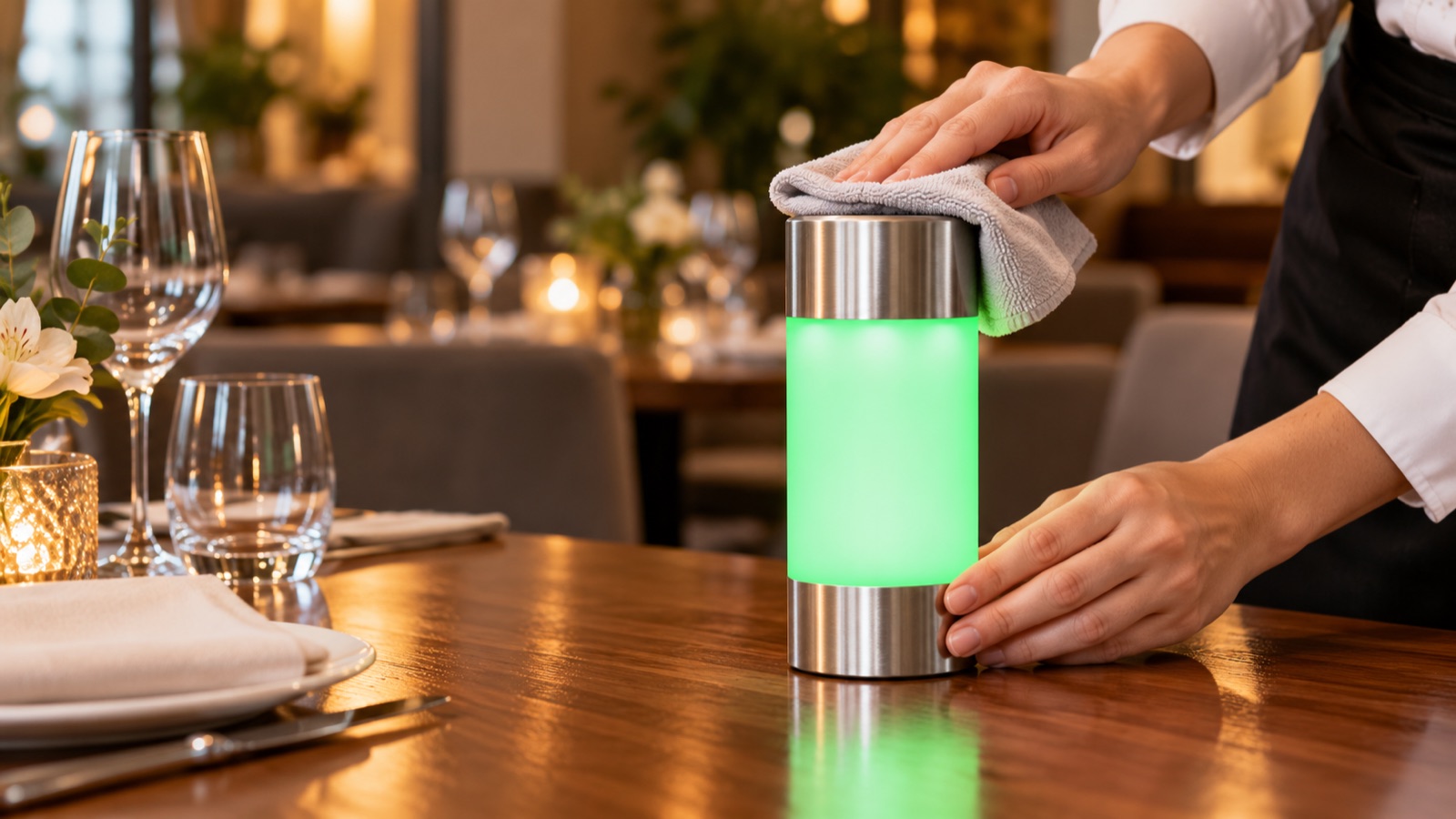
Quick answer: how should a restaurant clean rechargeable table lamps?
Use the care instructions for the exact lamp model, remove it from charging equipment, and clean it with a soft cloth and only a surface treatment confirmed as compatible by the supplier. Keep liquid away from charging contacts, ports, seams and electrical openings. Do not assume that a metal-looking finish is stainless steel, that a diffuser tolerates alcohol, or that a cordless lamp is waterproof. Before buying for a venue, request written care guidance and test the routine on an approved sample.
This is the safest useful starting point because “rechargeable table lamp” describes a product category, not a common material specification. Hospitality lamps may combine a diffuser, coated or bare metal, adhesives, optical parts, electronics and a battery. A cleaning agent safe for one surface can haze another; liquid that is harmless on an outer shell can still damage a connector or enter a seam.
Introduction: cleaning is an operating requirement, not a last-minute detail
Restaurant teams handle table lamps repeatedly. A lamp may move from a charging shelf to a service station, then to a guest table, back to the wash-up area and eventually to storage. It can collect fingerprints, food splashes, dust and residue from cleaning products used on nearby furniture. The care routine therefore affects appearance, staff time and the condition of charging parts.
Buyers often ask for a lamp that is “easy to clean.” That phrase needs to become a repeatable procedure. Ask which surfaces can be wiped, which products are permitted, whether the unit must be switched off or cooled first, and how staff should protect charging interfaces. If an operator cannot explain the method in one short checklist, the first step is to obtain manufacturer guidance—not to improvise a stronger cleaner.
This article gives buyers and operators a model-neutral evaluation method. It does not claim that JBTD-137 has been tested with a particular chemical or cleaning protocol. Public product information identifies it as a rechargeable flip table lamp with stainless-steel-looking end caps and a translucent center, but does not provide a care manual, a verified material schedule, or a chemical compatibility chart. Treat those descriptions as a request for supplier confirmation, not permission to apply a product. See the JBTD-137 product information and request current model-specific care documents.
Why care instructions must be model-specific
The exposed surface is only one part of a lamp. Beneath it may be a light source, battery, control board and wiring. Charging may take place through a port, dock, contacts or a supplied multi-lamp configuration. The outer appearance alone does not show which components tolerate moisture or chemical exposure.
Even a basic damp wipe raises several separate questions:
- Is the diffuser polycarbonate, acrylic, glass or another material?
- Is the metal bare, plated, anodized, painted or clear-coated?
- Are the end-cap edges sealed, or are there openings or joints nearby?
- Where are charging contacts, sockets, switches and seams?
- Does the supplier permit a damp cloth, a specific detergent, or a disinfectant?
- Must staff wait for the lamp to cool or dry before use or charging?
If the answer is not documented, do not infer it from the product photograph. “Metal finish” is not a material certificate. “Cordless” does not mean sealed against splashes. A manufacturer may also update a finish or component between revisions, so the instruction should identify the SKU and, where applicable, the revision.
Separate cleaning from disinfection
Cleaning removes visible soil. Disinfection is a separate process that uses a product under specific contact-time and surface-compatibility conditions. A restaurant should follow applicable local food-safety and workplace requirements for its facility, but that does not establish that every lamp can be exposed to the same chemical. The lamp supplier should confirm the surface compatibility and method for the exact model.
Do not describe a wipe-down as sterilization. Do not promise that a lamp is “food-safe,” “antibacterial,” or “sanitized” without relevant evidence. For procurement, request a clear instruction that distinguishes ordinary cleaning from any permitted disinfection procedure, including what must be kept dry.
A practical pre-service and between-service care routine
The following is a buyer-side workflow for discussion with the manufacturer. It is not an approved JBTD-137 procedure. Use it only after the supplier confirms the method for the actual product.
1. Identify the model and review the current instructions
Keep the care sheet with the product specification and staff operating guide. Confirm it applies to the exact SKU, finish, charging arrangement and production revision. If an order includes multiple lamp models, label the instructions so staff do not transfer a cleaner or method from one model to another.
Ask the supplier to state the approved cloth type, permitted cleaning solution (if any), whether the cloth may be damp, and which areas must remain dry. Also ask whether the lamp should be switched off, disconnected, or allowed to cool before handling. If a material or method has not been validated, make that explicit.
2. Remove the lamp from its charging setup
Do not clean a lamp while it is connected to a charger unless the manufacturer explicitly says that this is permitted. Remove it from its dock or charging panel and move it to a dry, stable work surface. This also prevents a wet cloth from contacting neighboring electrical equipment.
For a shared charger, keep the charger itself outside the cleaning area. The staff member should be able to distinguish the lamp’s external surface from its charging interface. Avoid placing wet cloths or used wipes on charging shelves, trays or power adapters.
3. Remove loose soil before wiping
If crumbs or dust are present, remove them gently with a clean, dry, non-abrasive cloth. Rubbing grit across a diffuser or coated finish can create marks. Do not use a scouring pad, abrasive powder, blade or stiff brush unless the product manual explicitly permits it.
For food residue, follow the model’s approved method. Do not scrape at a diffuser edge or push residue into a seam. If staff cannot remove a mark without force, quarantine the lamp for review instead of escalating to an unapproved chemical.
4. Wipe only the approved surfaces
Apply any approved liquid to the cloth rather than pouring or spraying it onto the lamp, unless the manufacturer specifies otherwise. Wipe the permitted external surfaces with light pressure. Avoid ports, switches, seams, openings, charging contacts and exposed connectors. Do not immerse the lamp or rinse it under a tap unless the product is expressly designed and documented for that treatment.
Keep separate cloths for cleaning and for drying where the supplier calls for a dry finish. A cloth used on table cleaner or another chemical should not be reused on the lamp without being washed and checked for residue.
5. Inspect, dry and return to the workflow
Look for residue, clouding, finish change, loosened parts, cracks, sticky controls or moisture at the charging interface. If the approved method requires drying, wait for the stated condition before charging. Do not put a damp lamp into a charging rack simply to meet a service deadline.
Record recurring defects by model and date. A pattern—such as haze near the top edge or residue around an interface—can reveal either a technique issue or a compatibility problem that the supplier needs to investigate.
Build a cleaning checklist the team can actually follow
A short checklist is more useful than a paragraph in a binder. It should reflect the supplier’s model-specific instruction and the restaurant’s food-safety procedures. A practical template may include:
- Model and finish covered by the procedure.
- Approved cloth and permitted solution, if any.
- Areas that must remain dry.
- Whether the unit must be switched off, unplugged or cooled.
- How to handle food residue without abrasion.
- Drying condition before returning to a charger.
- Visual defects that require the lamp to be removed from service.
- Who records repeated damage and contacts the supplier.
Use plain words and, if useful, a photograph of the permitted wipe area. Do not add an unverified icon such as a water droplet with a “safe” mark; that can imply an ingress rating that the model does not have. For multilingual staff, translate the approved procedure rather than asking each team to infer it.
How buyers can verify cleanability before a bulk order
Do not evaluate cleaning from a catalogue photo. Add a controlled care review to the sample approval plan. It should test the approved method on the actual finish and production version under ordinary staff conditions.
Ask the supplier focused questions
Send the supplier a short written list rather than asking only, “Is it easy to clean?” For example:
- What are the material and finish of each exposed component?
- Which cloth and solutions are permitted, and which are prohibited?
- Can the diffuser be wiped with a damp cloth? If so, what does “damp” mean in the instruction?
- Where are the charging contacts, ports and moisture-sensitive openings?
- Does the lamp need to cool or dry before charging?
- Is any disinfectant compatibility documented for this model and finish?
- What visible change should trigger removal from service?
- Does the instruction differ for a shared charging system or replacement parts?
Request that the answers refer to a specific model and finish. If the answer is “most cleaners are fine,” ask the supplier to identify the tested products and the evidence. Do not translate a general statement into compatibility with bleach, alcohol, quaternary ammonium products or another chemical class.
Conduct a small, documented sample review
Agree on the procedure before the trial. Use one approved lamp and a clean work surface. Record the lamp’s model, finish, production revision if known, cloth, permitted solution, number of wipe cycles, drying interval and observations. The test should be limited to the supplier-authorized method. It is not a durability certification or a substitute for a laboratory evaluation.
Inspect the same marked areas under consistent lighting before and after the trial. Look for visible haze, color shift, streaking, corrosion, adhesive lift, loose rings, surface tackiness or residue around joints. Take reference photos and ask the supplier to review any change before extending the trial to more lamps.
If the lamp will be used in a busy operation, include the staff member who will perform the task. Ask them to follow the instruction without coaching. Note whether the model is easy to identify, whether the charging side is obvious and whether the checklist fits the turnover routine. This provides genuine operational evidence about the process without inventing a factory test or claiming a customer case.
Cleaning and charging: keep the workflows separate
Cleaning and charging often happen in the same back-of-house area, but they should be planned as distinct tasks. The charger requires a dry, orderly setup. Cleaning requires cloths and possibly an approved solution. Mixing the two increases the chance that moisture or residue reaches electrical interfaces.
Map the workflow from collection to return:
| Stage | Buyer-side control | Evidence to request |
|---|---|---|
| Collect used lamps | Separate from ready-to-use stock | Staff handling sequence |
| Clean external surfaces | Use model-approved method only | Care instruction and approved materials |
| Dry/inspect | Keep charging areas clear | Supplier drying requirement and defect criteria |
| Charge | Use the specified matching equipment | Model-specific charging setup and input details |
| Return to service | Store clean lamps separately | Storage/handling recommendation |
The JBTD-137 product page lists a 12 V DC / 0.3 A charging input per lamp and a specified 12 V DC / 10 A / 120 W adapter for its matching shared charging setup. These are product-page details, not a cleaning specification; verify the configuration and accompanying documents for the order. Keep adapters and charging interfaces away from liquids, and do not infer that the adapter itself is suitable for a wet area.
If several staff members share charging duties, label the charging position and the cleaning station. A clear “clean and dry before charging” step can reduce ambiguity, but the exact drying instruction must come from the manufacturer. Do not build a rule around a guessed number of minutes.
What damage should remove a lamp from service?
Operators should stop using a lamp if there is visible damage that could affect safe operation or reliable charging. The supplier should define the exact defect criteria, but buyers can ask about cracks, loose caps, exposed wiring, unusual heat, persistent flicker, a damaged charging port, corrosion, swelling or a battery-related change. This list is a request for handling guidance, not a diagnosis.
Do not repair the lamp with adhesive, tape or a substitute charger unless the manufacturer authorizes that repair. Mark the unit, move it away from charging stock and report the model, date, symptom and charging arrangement. If multiple units show a similar issue, retain the records and contact the supplier before applying a new cleaning chemical or changing the procedure.
For an incoming shipment, the buyer’s inspection can also establish a baseline: photograph representative finishes, confirm the correct accessories, check that the supplied care documentation matches the order and record visible damage before deployment. This is a proposed receiving-control practice, not a claim that a specific factory or shipment has completed such an inspection.
FAQ: cleaning commercial rechargeable table lamps
Can I use alcohol wipes on a rechargeable table lamp?
Only if the supplier confirms compatibility for the exact model and finish. Alcohol may affect certain plastics, coatings, adhesives or printed surfaces. A wipe marketed for electronics is not automatically suitable for a hospitality lamp.
Are cordless table lamps waterproof because they have no cable?
No. Cordless operation says how the lamp is powered during use; it does not establish protection against water or cleaning liquids. Request the model’s documented ingress rating if one exists, and follow the care manual.
Can staff spray disinfectant directly onto the diffuser?
Do not do this unless the manufacturer’s instruction explicitly permits it. Spraying can let liquid enter seams, ports or controls. Ask which method is authorized and whether a specific contact time is supported.
How often should a restaurant clean its table lamps?
Set frequency according to the venue’s operating and hygiene procedures, observed soil, guest turnover and the manufacturer’s care instructions. There is no universal schedule that can be derived from the product category alone.
Can the lamp be cleaned while it is on a charging rack?
Do not assume so. Separate cleaning from charging and follow the supplier’s instructions for the lamp and charging equipment. Keep liquid and damp cloths away from powered interfaces.
What cleaning information should an importer request?
Request the model-specific care sheet, component materials and finishes, permitted and prohibited agents, protected openings, drying requirements, damage criteria and any documented disinfectant compatibility. Keep the document with the purchase specification.
Conclusion: make care instructions part of the purchase specification
For a hospitality lamp, cleanability should be verified as a workflow rather than accepted as a marketing adjective. Confirm the surface materials, request a model-specific care instruction, keep cleaning separate from charging, and evaluate the approved routine on a sample. If a supplier cannot identify a compatible method, do not improvise with a stronger chemical or present the product as water-resistant.
The product information currently available for JBTD-137 establishes its lamp type and selected electrical details, but not a cleaning chemistry or ingress rating. Buyers should request the current care documentation for the exact quotation configuration before standardizing a procedure. That approach gives purchasing, operations and facilities teams a common, traceable basis for use.
Send your requirements to Jbian.
Send your requirements to Jbian to request the JBTD-137 specification, current care guidance and a quotation for your restaurant or hospitality project. Include the intended finish, charging arrangement, market and cleaning method you need to support.