How to Calculate Commercial Rechargeable Table Lamp Total Cost of Ownership
A buyer-focused worksheet for comparing complete lamp fleets without turning prices, lifetimes or operating assumptions into unsupported product claims.
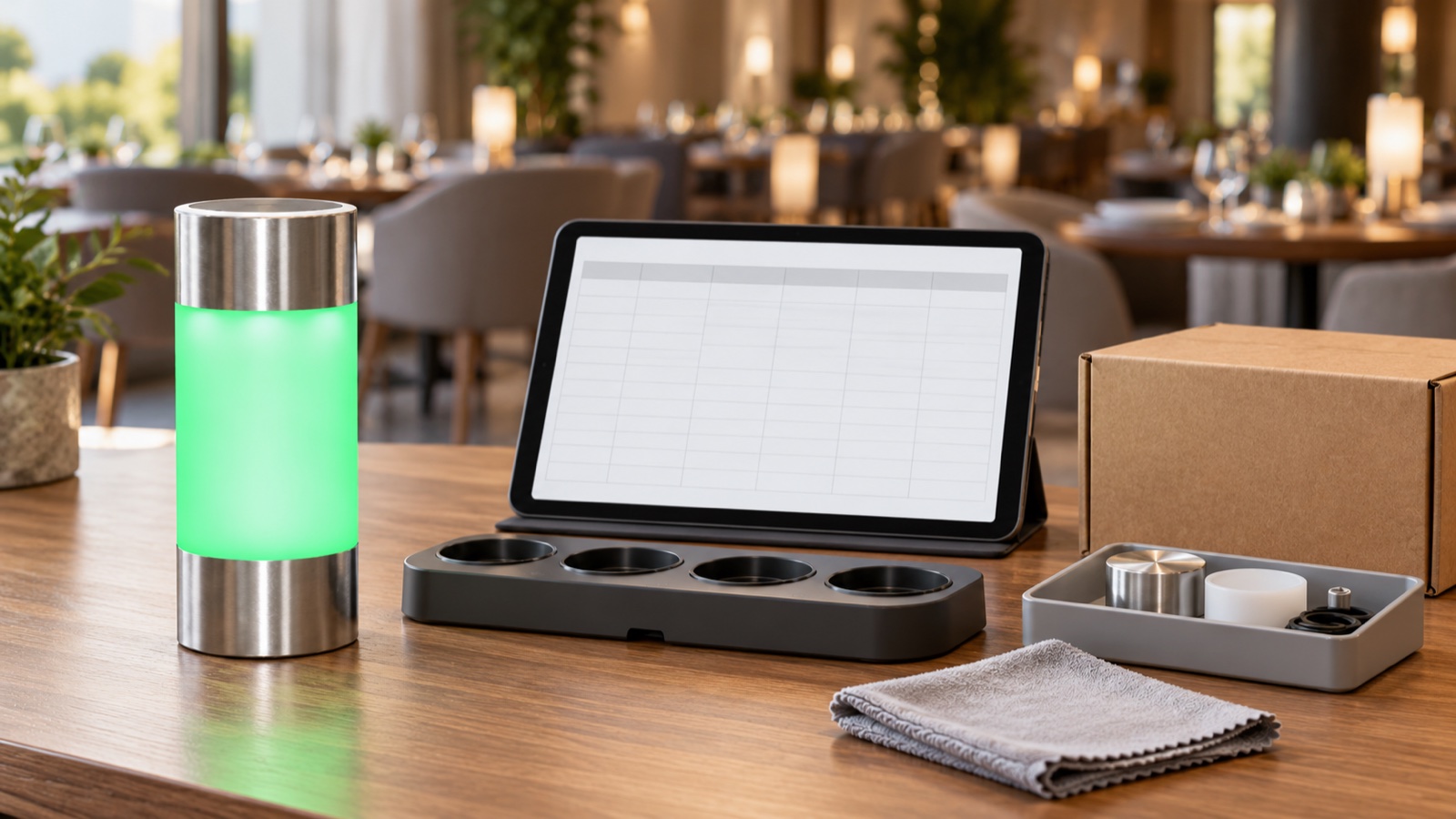
Quick answer: how should a buyer calculate rechargeable table lamp total cost of ownership?
Calculate a commercial rechargeable table lamp fleet as a system, not as a unit-price purchase. Add the lamps, charging hardware, opening spares, storage and installation preparation; then estimate staff handling, cleaning, electricity, replacement parts or units, losses, inspections, freight and end-of-life handling over a comparison period. Subtract any documented residual value only if it is realistic.
Use the same fleet size, service schedule, currency, delivery basis and time horizon for every supplier. Keep quoted facts separate from buyer assumptions. A low unit price is not automatically a low total cost, while a higher-priced system is not automatically better.
For JBTD-137, JB's published product information identifies a 2600 mAh battery capacity, 0.6 W rated lamp power, 12 V DC / 0.3 A charging input per lamp, and a specified 12 V DC / 10 A / 120 W adapter for the matching shared setup of up to 25 lamps. These figures help define the quoted configuration; they do not establish runtime, charge duration, battery life, electricity use over a year or replacement frequency.
Why total cost of ownership belongs in a hospitality lamp comparison
Restaurant and hotel buyers receive a price per lamp, but the operating object is a fleet. Staff collect, clean, charge and redistribute the lamps while managing unavailable units. Charging positions, outlets, storage and spare stock affect readiness for the next service.
The US Department of Energy describes life-cycle cost as the total cost of ownership over a product's lifetime and groups initial, energy, maintenance and disposal costs. The US General Services Administration likewise distinguishes initial investment from future costs over a defined period. Those frameworks are broader than table lamps, but the principle is useful: compare alternatives with one consistent boundary.
For a hospitality lamp project, a TCO worksheet does not produce a universal savings claim. It reveals which costs are quoted, venue-dependent or still require a pilot.
Define one comparison boundary before entering costs
Choose the operating period
Use a period that matches the decision, such as one, three or five years. Do not select a service life because it makes one option look favorable. If useful life is not supported, compare several scenarios and label them as assumptions.
A three-year worksheet can show the effect of different replacement rates without claiming that a lamp will last exactly three years. Keep the same period for every alternative.
Fix the fleet and service assumptions
Record active tables, lamps per table, opening spares, service days, service periods and the peak charging return. For several venues, build one worksheet per operating pattern before combining totals.
Also state:
- destination market and currency;
- quoted Incoterm and named place;
- taxes or duties included or excluded from the buyer model;
- standard or customized product configuration;
- charging equipment and plug version;
- planned replacement and inspection method;
- discount rate, if future cash flows are converted to present value.
Without these boundaries, two totals can be mathematically correct but commercially incomparable.
Build the total-cost worksheet in six cost groups
| Cost group | Include | Evidence to request | Common omission |
|---|---|---|---|
| Acquisition | Lamps, approved variants, opening spares | Itemized quotation and exact model | Comparing different configurations as if identical |
| Charging and setup | Bases, adapters, cords, plugs, shelving, outlet work | Bill of materials and matched configuration | Assuming a lamp-only price includes the complete charging system |
| Operations | Collection, placement, charging and recordkeeping labor | Timed pilot using the proposed workflow | Using an untested handling-time estimate as fact |
| Care and replacement | Cleaning supplies, inspection, parts, damaged or missing units | Care guidance, parts policy and buyer records | Treating all failures as battery failures |
| Logistics and commercial | Packaging, freight, insurance, customs handling and local delivery | Pack data and named delivery basis | Mixing EXW, FOB and delivered prices |
| End of use | Withdrawal, data or inventory closeout, recycling or disposal handling | Destination-specific responsible-party review | Assuming disposal is free or identical in every market |
The worksheet should show source and confidence beside each value. Label a supplier quote, a buyer payroll assumption, a pilot observation and a scenario estimate differently.
Cost group 1: acquisition and opening fleet
Begin with the exact model, finish, control function, plug option and packaging configuration. Separate samples, pilot units and bulk units. A customized finish or private-label package should not be silently treated as the same cost and timing as a catalogue version.
A practical opening-fleet line is:
Opening fleet cost = active lamps + operating reserve + approved opening spares
The reserve is an operating decision, not a universal percentage. A property with several outlets, private events or a remote replacement route may choose a different reserve from a single dining room. Ask suppliers to quote every variant and accessory on separate lines, as described in the commercial lamp RFQ checklist.
Do not multiply a sample price by the bulk quantity unless the supplier confirms that basis. Record MOQ, price breaks, quote validity and included packaging without presenting them as fixed JB policy.
Cost group 2: charging hardware and installation preparation
Rechargeable lamps require a defined charging system. Include the number of charging positions, bases or rails, adapters, power cords, plug versions, protective shelving or trolley space, cable management and any qualified electrical work at the venue.
For JBTD-137, a matching shared configuration is specified for up to 25 lamps with a 12 V DC / 10 A / 120 W adapter. “Up to 25” does not mean that any rack, adapter or cable is suitable. The quotation should identify the exact matched components and quantities. The per-lamp 12 V DC / 0.3 A input is not a complete fleet-sizing calculation.
Use the multi-lamp charging capacity guide to map the peak return period and available charging window. If only part of the fleet can charge at once, include the extra handling or rotation in the operating model rather than assuming all lamps are ready simultaneously.
Installation preparation may include a ventilated, protected location; reachable outlets; separation from wet cleaning work; labels; and a simple responsibility map. These are planning categories, not a claim that JBTD-137 has a particular environmental rating.
Cost group 3: staff workflow and operating labor
Labor can be material, but it should be measured rather than invented. During a representative pilot, time the full sequence:
- collect lamps after service;
- inspect and separate exceptions;
- wipe or clean according to approved guidance;
- place each lamp into the correct charging position;
- record missing or unavailable units if the venue uses a log;
- remove and distribute lamps before the next service.
Measure several shifts and record fleet size, staffing and exceptions. Do not use a supplier's generic “minutes saved” claim as your venue's labor result.
A simple annual labor scenario is:
Annual workflow labor = minutes per cycle × cycles per year ÷ 60 × loaded labor rate
This is a buyer calculation. The inputs should come from the property, and the result should be presented as a scenario rather than a product guarantee. If one option uses more charging positions but reduces rotation, the worksheet makes that trade-off visible.
Cost group 4: electricity without false precision
Annual electricity cost requires measured or documented energy per charging cycle, charging frequency, system losses and local tariff. Battery capacity in mAh and rated lamp power in watts are not enough to calculate an accurate annual charging bill. They describe different electrical quantities and do not include charging efficiency, standby behavior or operating mode.
Use a plug-in energy meter or suitable test method during the pilot if electricity cost is decision-relevant. Record the exact lamp, adapter, number of lamps, initial state, end criterion and measurement period. Then calculate:
Annual charging electricity cost = measured kWh per defined cycle × cycles per year × local cost per kWh
Do not publish a precise annual value from an assumed runtime or from 2600 mAh alone. The public JB source reviewed for this guide does not establish a JBTD-137 charge duration, charging efficiency or annual energy use.
Cost group 5: cleaning, inspection, losses and replacement
Separate causes instead of using one unexplained replacement percentage. Useful lines include:
- damaged housing or light diffuser;
- charging accessory damage or loss;
- finish rejected after cleaning;
- lamp missing from the fleet;
- control or visual-state exception;
- battery or charging performance requiring investigation;
- unit withdrawn because documentation or configuration no longer matches.
The commercial lamp cleaning and maintenance guide explains how to build an approved care workflow without assigning an unverified chemical compatibility or ingress rating. Track actual incidents by cause after deployment; use those records to update the forecast.
Ask whether parts, batteries or accessories can be replaced, by whom, under what documented method and with what effect on applicable evidence. Do not assume field replacement is permitted. Likewise, do not invent a warranty term or service-life claim when comparing alternatives.
Cost group 6: packaging, freight and destination costs
Normalize the commercial basis before comparing totals. A factory price, port price and delivered price allocate responsibility differently. Record the Incoterm version, named place, currency and exclusions. Ask for preliminary carton quantity, dimensions and gross weight when available, then update freight after packaging approval.
For private label, include artwork, labels, instructions, packaging samples or setup charges only when quoted. Treat buyer changes separately from supplier deviations.
Battery-powered product shipping may require model- and shipment-specific information. Public JBTD-137 data reviewed here do not establish battery chemistry, nominal voltage, watt-hours, UN 38.3 evidence or transport eligibility. Review the lithium-battery shipping document guide and confirm the final document pack with responsible suppliers, carriers and specialists.
Use scenarios instead of unsupported lifetime promises
When evidence is incomplete, create low, base and high scenarios. Change only the uncertain inputs, such as annual replacement quantity, staff minutes per cycle, freight or analysis period. Keep quoted acquisition and charging configuration unchanged unless the supplier quote changes.
| Input | Low scenario | Base scenario | High scenario | Source owner |
|---|---|---|---|---|
| Comparison period | Buyer-selected period | Same period | Same period | Buyer |
| Workflow minutes | Pilot lower observation | Pilot central observation | Pilot upper observation | Venue pilot |
| Replacement units | Documented low assumption | Working assumption | Stress assumption | Buyer records |
| Freight | Current lower quote | Selected planning quote | Contingency quote | Forwarder |
| Electricity | Measured cycle × low tariff | Measured cycle × current tariff | Measured cycle × high tariff | Buyer/test record |
Do not call the base scenario “expected” unless the evidence supports that label. Report the range and the inputs that drive it.
Convert the worksheet into comparable supplier questions
Ask each shortlisted supplier to answer the same questions:
- What exact lamp model and revision is quoted?
- Which bases, adapters, cords and plug versions are included, and in what quantities?
- What charging configuration is supported in writing?
- Which runtime, charging or photometric values are available, under what conditions?
- What cleaning and inspection guidance applies to the exact finish?
- Which components are replaceable, and who is authorized to replace them?
- What standard and custom packaging is included?
- What are the quotation basis, named place, validity, schedule assumptions and exclusions?
- Which documents apply to the exact model, battery and destination?
- How are nonconforming or unavailable units handled under the quoted terms?
An unanswered line is not zero cost. Mark it “open” with an owner and date.
Validate the model with a pilot and shipment inspection plan
A spreadsheet cannot prove physical performance. Use a representative sample or venue pilot to test table fit, guest and staff interaction, charging workflow, cleaning, storage and the specific operating schedule. The pilot-before-bulk-order guide provides a structured approach.
Before shipment, align inspection with the approved product and packaging references. Possible checks include identity, quantity, visible workmanship, operation, accessories, labels and pack condition. Specialized electrical, battery or compliance checks require suitable methods and competent reviewers. Do not describe a proposed factory test or shipment inspection as completed evidence.
After launch, compare actual staff time, exceptions, losses and replacement purchases with the assumptions. TCO becomes more useful when it is updated from operating records rather than left as a procurement-only estimate.
A practical rechargeable lamp TCO worksheet
Create one row per cost item and use these columns:
- cost group;
- item and exact configuration;
- quantity;
- unit cost and currency;
- timing or frequency;
- comparison-period cost;
- source: quote, pilot, invoice, meter or assumption;
- confidence or scenario;
- inclusion or exclusion note;
- owner and next verification date.
Then summarize:
Initial system cost = lamps + charging equipment + opening spares + storage/setup + approved packaging and initial logistics
Operating-period cost = staff workflow + electricity + care/inspection + replacement/losses + recurring logistics + end-of-use handling
TCO for the stated period = initial system cost + operating-period cost − documented residual value
If comparing fleets of different sizes, also show cost per active table or cost per available lamp-service day, but only after the total is built from consistent inputs.
FAQ
Is the lowest lamp unit price usually the lowest total cost?
Not necessarily. The complete result depends on charging equipment, opening spares, staff workflow, replacement, logistics and the comparison period. It is also possible for a higher-priced option to have higher total cost. Calculate each alternative with the same boundary.
Can I calculate JBTD-137 annual electricity cost from 2600 mAh and 0.6 W?
No. Those values do not establish energy drawn from the outlet, operating mode, charging efficiency, frequency or local tariff. Measure or obtain documented cycle energy for the exact system before calculating annual electricity cost.
How many spare lamps should a restaurant buy?
There is no universal percentage. Base the reserve on active tables, events, charging rotation, replacement route, historical losses and acceptable service risk. Label the selected quantity as a buyer assumption until operating data support it.
Should labor be included if existing staff handle the lamps?
Yes, if the workflow uses staff time that differs between alternatives. Use the loaded labor rate and measured minutes from a representative pilot. Do not assume the time is free simply because the employees are already scheduled.
What does the JBTD-137 up-to-25-lamp charging figure mean for TCO?
It applies only to the matching shared setup with the specified 12 V DC / 10 A / 120 W adapter. Confirm the exact base, adapter, cords and supported positions in the quotation. It is not permission to combine arbitrary components.
How often should the TCO worksheet be updated?
Update it when the product configuration, quotation, packaging, freight, tariff, staff process or replacement evidence changes. After deployment, review it at a defined interval using actual venue records.
Conclusion
Commercial rechargeable table lamp TCO is a controlled comparison, not a marketing claim. Define the fleet and period, itemize the complete charging system, measure staff workflow, avoid false electricity precision, separate replacement causes, normalize delivery terms and keep assumptions visible.
For JBTD-137, use the published model values to identify the proposed configuration while leaving runtime, charge duration, energy use, useful life, replacement rate, certification, lead time and warranty open until supported by the exact quotation and evidence.
Send your requirements to Jbian.
Ask Jbian for an itemized lamp-and-charging quotation. Send your destination, active table count, planned spares, service schedule, charging window, plug requirement and packaging needs. Jbian can identify the proposed JBTD-137 system scope and the information still needed for your TCO worksheet.