What to Include in a Commercial Rechargeable Table Lamp RFQ
A practical buyer checklist for creating comparable quotations without turning assumptions into product claims.
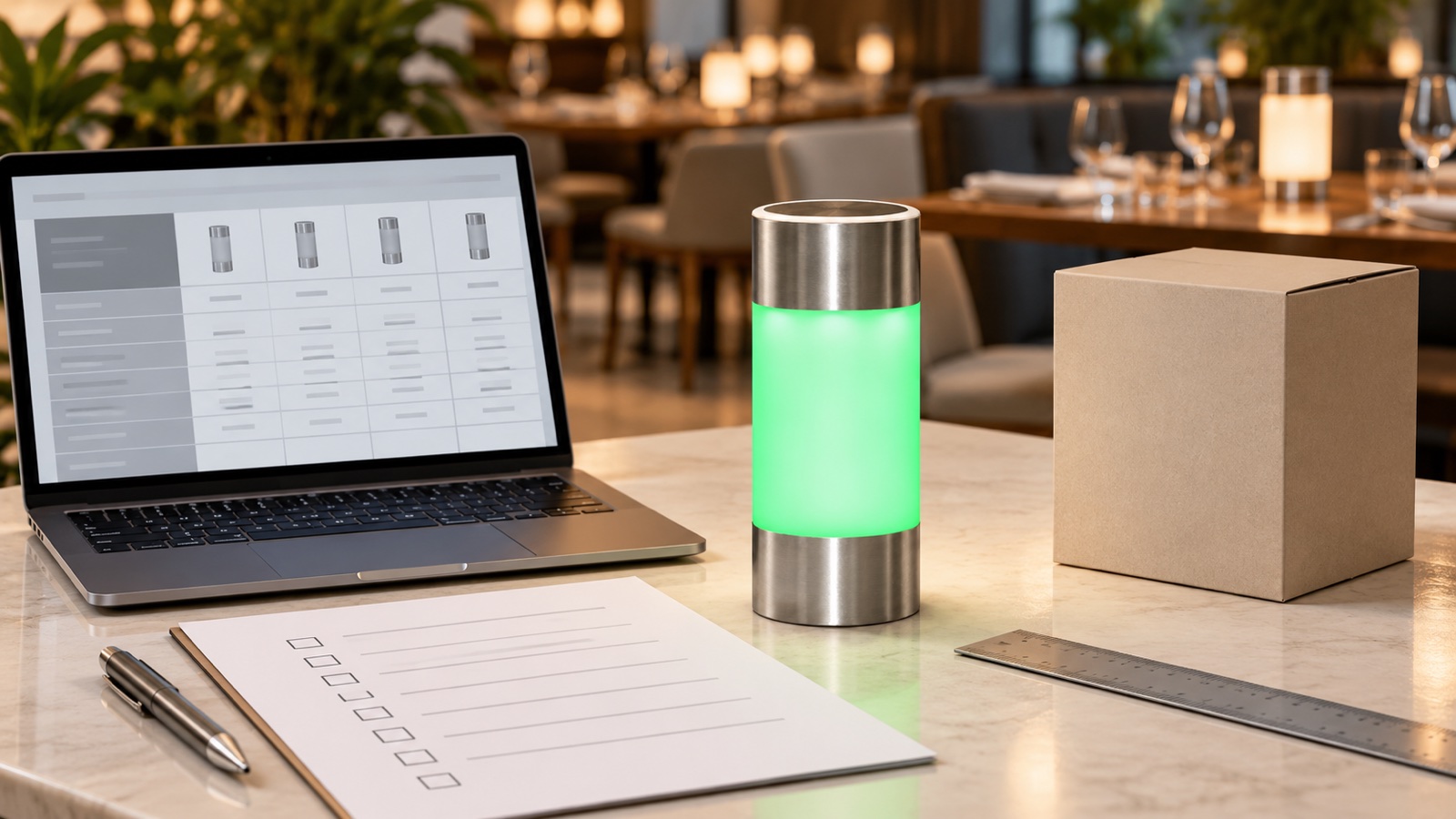
Quick answer: what should a commercial rechargeable table lamp RFQ include?
A useful commercial rechargeable table lamp request for quotation identifies the application, destination, exact product or brief, quantity by configuration, charging equipment, appearance, packaging, documents, sample plan, delivery basis and timing. It asks the supplier to state assumptions, deviations and the exact model behind every value.
Make known requirements visible and unknowns explicit. If runtime, light output, charge duration or evidence is open, write “supplier to propose and document” instead of guessing.
For JBTD-137, start with published data and request written confirmation. JB sources state 2600 mAh, 0.6 W, 12 V DC / 0.3 A per lamp, and a specified 12 V DC / 10 A / 120 W adapter for a matching shared setup of up to 25 lamps. These do not establish runtime, charge duration, brightness, ingress protection or universal suitability.
Why a clear RFQ matters more than a short “best price” message
“Please quote 100 rechargeable restaurant lamps” does not identify the finish, charging setup, plug, packaging, destination or expected documents. One supplier may quote lamps only while another includes bases and adapters. Those prices are not comparable.
A structured RFQ connects the requirement to an identifiable product and exposes open decisions. It is not a purchase order; the sample, quotation, order confirmation and inspection criteria should reconcile to the same product revision.
Start with the application, buyer type and destination
Describe the real operating environment
State whether the lamps are for a restaurant, hotel lounge, event fleet, distributor program or private-label range. Add the operating zones and service pattern. A dinner-only restaurant and an all-day hotel outlet may need different collection and charging routines.
Give practical context:
- indoor, covered or exposed placement;
- typical table size and seating arrangement;
- smallest table where the lamp must fit;
- number of service periods per day;
- time available for collection and charging;
- storage location and available outlets;
- whether guests or staff operate the lamp;
- whether the product must provide atmosphere, menu support, a service cue or several functions.
If the location may be exposed to rain, humidity, cleaning spray, heat or impact, describe the condition and ask for documented options. Do not infer “waterproof” from an outdoor image.
Identify the market and sales channel
Specify the destination and whether the product is for your venue, distribution or private label. These roles can affect labels, instructions and evidence. Do not request a generic “international certificate.” Ask which exact model each destination-relevant document covers. European Commission guidance also makes clear that CE marking applies only where relevant EU rules require it and is not a universal central approval. The RFQ cannot replace a compliance review.
Lock the product identity and functional scope
Catalogue selection
If you already selected a product, state the model code and attach or link the source page. Include a dated copy or revision of any specification sheet used for the request. Ask the quotation to repeat the exact model, configuration and included accessories rather than replacing them with a broad family name.
For JBTD-137, the functional brief should distinguish its two documented visual states: green for normal dining and red as a local visual service-request cue. The red state is not described as a radio, pager, mobile, display or point-of-sale notification. If your project needs an electronic call system, say so separately and review the visual lamp versus wireless call system guide.
Functional brief when the model is open
If you want the supplier to recommend a model, define the job instead of inventing a product code. Separate mandatory requirements from preferences and questions. For example:
- Mandatory: stable on a defined tabletop, rechargeable, suitable for the stated indoor operating zone, and supported by a documented charging method.
- Preferred: a finish direction that coordinates with the venue interior and a shared charging arrangement.
- Supplier to confirm: measured light information, available controls, operating time under stated conditions, charge duration, cleaning guidance and document coverage.
This format allows an honest proposal. It also prevents a preferred visual detail from being mistaken for a non-negotiable technical requirement.
State quantity by model, variant and project stage
Give each finish, plug, logo or packaging configuration a separate line. Distinguish sample quantity, initial order and non-binding forecast. For a venue fleet, show the calculation:
- lamps required on active tables;
- lamps reserved for replacement or private events;
- units expected to be charging or awaiting preparation;
- opening spares, if your operating plan includes them;
- charging positions needed at the peak return period.
Lamp quantity and simultaneous charging positions are not identical. Use the multi-lamp charging planning guide to document return peaks, charging windows and matched equipment rather than sizing a system from adapter wattage alone.
Use a requirement matrix instead of scattered questions
A simple matrix helps suppliers answer each field and identify evidence. Keep “required value” separate from “supplier response” so proposed alternatives remain visible.
| RFQ field | Buyer should provide | Supplier should return | Why it matters |
|---|---|---|---|
| Product identity | Model or functional brief | Exact quoted model and revision | Prevents family-level substitutions |
| Quantity | Units by variant and stage | Price break, MOQ and included quantity basis | Keeps sample, trial and bulk scope separate |
| Physical form | Table constraints, preferred dimensions and finish direction | Drawing, dimensions, materials and finish reference | Supports fit and appearance review |
| Light and controls | Intended task and required modes | Available modes and model-specific measured data | Avoids treating wattage as brightness |
| Battery operation | Service schedule and desired acceptance method | Battery data, runtime conditions and charge information | Connects performance to real use |
| Charging | Peak lamp return and available charging window | Exact base, adapter, cables, plug and supported positions | Prevents incomplete or mismatched systems |
| Documents | Destination and evidence list to review | Model coverage, issuer, report or declaration reference | Links evidence to the offered item |
| Packaging | Channel, label, artwork and handling needs | Pack structure, quantities, dimensions and approval process | Affects protection, branding and freight |
| Delivery | Destination, requested term and target window | Incoterm with named place, schedule basis and validity | Makes commercial offers comparable |
If a field is unknown, mark it pending. Describe the task and request evidence or a sample method instead of forcing an unsupported value.
Define the charging system as part of the product scope
Rechargeable lamps are a system purchase. A quotation should state whether it includes lamps only, individual charging leads, contact bases, multi-position equipment, adapters, power cords and plug versions. Ask for a line-by-line list and the quantity of each accessory.
For JBTD-137, the published values are model-specific: 12 V DC / 0.3 A input per lamp and a specified 12 V DC / 10 A / 120 W adapter for the matching shared setup of up to 25 lamps. “Up to 25” applies only to that matching configuration; it does not authorize connecting 25 lamps to any rack or power supply. EU, US and UK plug options are listed, but the required option must be confirmed in the quotation.
Ask the supplier to state any charging duration together with the test conditions, starting state, end criterion and exact equipment. The public JB source reviewed for this guide does not provide a verified JBTD-137 charge duration, so this RFQ must not invent one. Likewise, 2600 mAh is battery capacity, not a runtime promise.
Separate appearance requirements from measurable performance
Reference images communicate design direction but do not define dimensions, material, finish or light output. For a catalogue model, request its current drawing and finish reference. For OEM/ODM, list every proposed color, finish, logo, label, packaging or structural change separately and ask about feasibility, sample needs, cost and timing. A rendering is not approval; use a documented physical-sample process covering appearance, dimensions, function, accessories, label and packaging. See the OEM/ODM sample approval guide.
Request evidence without turning the RFQ into a logo collection
List the files your responsible compliance team needs for the destination and channel. Ask which model, configuration and revision each file covers; a logo or unrelated family report does not establish coverage.
The request may include, where applicable and determined by the project’s responsible specialists:
- product specification and drawing;
- battery identification and relevant technical information;
- declarations, reports or certification evidence required for the destination;
- instructions, warning labels and language versions;
- material or environmental declarations requested by the buyer;
- packaging and marking information;
- shipping documents for a battery-powered product.
Battery transport requirements depend on the battery and shipment. Public JBTD-137 information confirms capacity but not chemistry, nominal voltage, watt-hours, UN 38.3 evidence or transport eligibility. Use the battery-shipping document guide, then verify final files with the supplier, carrier and responsible professionals.
Define sample approval, factory testing and shipment inspection
Ask for a stage-appropriate sample plan. A catalogue sample confirms an existing model; a customized sample is reviewed against a change list; a venue pilot checks fit and handling. State who approves it and which records become the production reference:
- model and visible configuration;
- dimensions and table fit;
- finish and color reference;
- control behavior and visual states;
- charging equipment and included accessories;
- label, instructions and packaging mockup;
- agreed operating or light-evaluation method;
- permitted deviations and open items.
Treat “factory testing” and “shipment inspection” as defined processes. Ask which checks, sampling basis and acceptance criteria apply to the ordered model. Inspection can cover quantity, identity, visible workmanship, function, accessories, labels and packaging; specialized checks need appropriate methods and competent reviewers.
Make packaging and private-label scope quoteable
State whether you need standard, neutral or private-label packaging, including barcode, carton mark, instruction language, importer information and artwork status.
Ask the quotation to separate:
- lamp unit price;
- charging equipment and adapter price;
- sample cost;
- customization or tooling cost;
- artwork or packaging setup cost;
- spare parts or replacement accessories;
- freight, if requested.
Use estimated packing data for planning and require final values after approval.
Specify commercial terms with a named destination
State currency, quantity breaks, destination and delivery basis. Write any Incoterm with its named place or port and rule version; “FOB price” without a port is incomplete.
Ask every quotation to show:
- price and quantity basis for each line;
- MOQ and whether it applies by model, finish or artwork;
- payment terms;
- quotation validity;
- sample and production schedule assumptions;
- delivery term and named place;
- included and excluded costs;
- warranty terms, remedy and exclusions as a written proposal;
- assumptions, deviations and proposed substitutions.
No universal JB MOQ, lead time, warranty or price is verified in the reviewed source. Treat them as configuration-specific quotation fields.
Compare supplier replies on one normalized sheet
Copy every reply into the same structure. Check scope before price because a lower unit price may exclude chargers, packaging, documents, accessories or freight.
| Comparison question | Acceptable evidence | Decision note |
|---|---|---|
| Is the exact model identified? | Model code, specification revision and configuration | Reject or clarify family-only offers |
| Are all accessories listed? | Line items for bases, adapters, cords and plugs | Check quantities against fleet plan |
| Are unknowns visible? | Assumptions, exclusions and deviations | Do not let blanks become silent promises |
| Is performance model-specific? | Stated conditions and applicable report or test method | Avoid generic catalogue claims |
| Is packaging comparable? | Pack type, label/artwork scope and preliminary logistics data | Separate standard and custom versions |
| Is delivery comparable? | Incoterm, named place, schedule basis and validity | Normalize freight and responsibility |
| Is approval defined? | Sample, document and packaging sign-off sequence | Link the final order to approved references |
Keep the quotation, sample record and order confirmation aligned. Record revisions and reassess affected evidence.
A ready-to-send RFQ outline
Use this email or attachment sequence:
- Buyer and project: company, contact, venue or channel, destination and project stage.
- Application: indoor or other documented environment, table conditions, service role and operating schedule.
- Product: selected model or functional brief, mandatory requirements, preferences and open questions.
- Quantity: sample, pilot, initial order and non-binding forecast by configuration.
- Charging: lamps returned at peak, available charging window, required positions, outlet and plug information.
- Appearance/OEM: finish, color, logo, label, packaging and artwork status.
- Evidence: exact documents and model coverage to be reviewed for the destination.
- Approval: sample, testing, packaging and pre-shipment inspection expectations.
- Commercial reply: itemized price, MOQ, terms, validity, schedule, Incoterm with named place, inclusions and exclusions.
- Attachments: requirement matrix, venue photos or table drawing, references, artwork and revision list.
End with: “Please quote against this revision, identify every assumption or deviation, and keep alternatives on separate lines.”
Common RFQ mistakes to avoid
Asking for an unsupported performance promise
Do not calculate runtime from mAh and wattage or use wattage as a substitute for lumen output. Request exact-model data and conditions, then review a representative sample.
Treating the hero image as a specification
A product image can identify appearance, not dimensions, material, charging capacity, ingress protection or certification. Ask for the drawing and documents.
Mixing sample, pilot and bulk requirements
Give catalogue sample, customized approval sample and bulk stages separate quantities, objectives and owners. See the restaurant lamp pilot guide.
Hiding unknowns with vague wording
“High quality” and “long battery life” are not acceptance criteria. Describe the task and request a proposed value plus evidence.
FAQ
What information is needed for a wholesale table lamp quotation?
Provide application, destination, model or brief, quantity by variant, charging, packaging, document, sample, timing and delivery needs. Ask for the exact configuration, assumptions, exclusions, MOQ, price, schedule and evidence references.
Should I include a target price?
You may include a realistic target, but state its currency, quantity, accessories, packaging and delivery basis. It cannot replace the technical scope.
How do I request a JBTD-137 quotation?
State quantity, destination, plug, charging positions, service schedule and packaging. Ask the quote to confirm JBTD-137, its green/red function, exact base and specified adapter. Request written answers for runtime, charge duration, photometric and document questions not established by the public source.
Can I request 25-lamp charging in the RFQ?
Yes, if it matches your fleet plan. The up-to-25 limit applies only to the matching JBTD-137 shared setup and specified 12 V DC / 10 A / 120 W adapter. Confirm every component.
What should the supplier state when a requirement is unavailable?
Ask the supplier to mark it unavailable, pending or not applicable and explain alternatives. A visible deviation is better than an unsupported “complies.”
Is an RFQ enough to approve bulk production?
No. Bulk approval should reconcile the quote with the exact specification, documents, approved sample, packaging, order confirmation and inspection criteria.
Conclusion
A strong RFQ identifies the venue and market, locks the product or brief, separates accessories, defines charging, requests model-specific evidence, and makes packaging and delivery comparable. It records uncertainty so the supplier can answer instead of guess.
For JBTD-137, begin with documented values and its local green/red visual function. Keep unverified runtime, charge duration, brightness, IP, certification, MOQ, lead time and warranty statements out until supported.
Send your requirements to Jbian.
Ask Jbian for a product catalog and itemized quotation. Send your destination, venue type, lamp quantity, charging-window plan, selected finish or branding direction, packaging needs and required document list. Jbian can then identify the proposed JBTD-137 configuration, inclusions and open items for your review.