How to Pilot a Commercial Cordless Table Lamp Before a Bulk Order
A buyer-side evaluation plan that connects sample approval to the way restaurant and hotel teams actually use, return and prepare lamps.
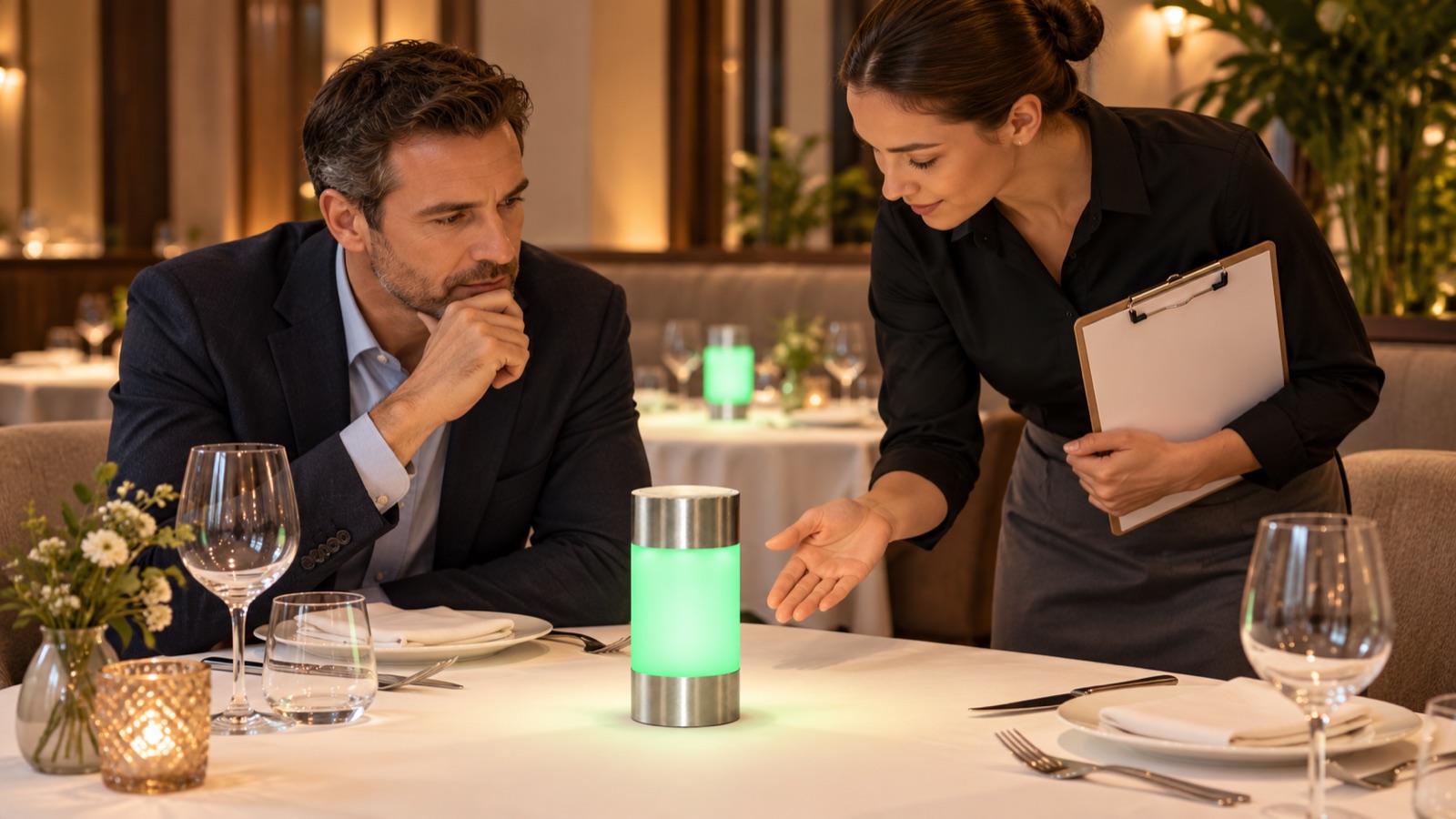
Quick answer: pilot the complete service routine, not just the lamp on a showroom table
Before a restaurant or hotel places a larger cordless-table-lamp order, evaluate a sample in the space and workflow where it will be used. Review table fit, light presentation, guest interaction, staff handling, cleaning, collection, charging, storage and response to faults. Record the exact model and accessories, agree what “acceptable” means before the trial, and send any performance questions to the supplier for model-specific evidence. A short pilot can reveal operational mismatches; it cannot establish long-term reliability, certification or factory-wide consistency by itself.
This guide describes a buyer-side evaluation plan, not a report of Jbian customer trials. It complements a battery-runtime test by examining the wider service cycle: how the lamp is used, returned, cleaned, charged and prepared for the next shift. For JBTD-137, the published product information documents a 2600 mAh battery, 0.6 W rated lamp power, a specified matched charging configuration and local green/red service states. It does not establish an unconditional runtime or charging duration, so those points must be confirmed separately.
Introduction: convert “we like the sample” into an orderable decision
A lamp can look appealing in a product photograph and still prove awkward on a small table, difficult to collect after service or confusing for staff who need to understand its light states. A sample review that asks only “does the design look right?” is unlikely to prepare a buyer for a multi-zone rollout. Procurement, venue operations, facilities and any project designer should agree on the review criteria before the sample is approved.
The pilot does not need to be complicated. Its purpose is to put the same candidate through representative tasks, note where the product and the venue workflow meet, and decide whether to approve it, request a change, gather more evidence or reject it. The answer depends on actual requirements. Do not invent a pass rate or claim that a certain number of nights proves commercial durability.
Step 1: define the decision the pilot must support
Write one sentence describing the purchase decision. Examples include: “Can this model provide the visual table cue we need in the private dining room?” or “Can staff return and recharge this lamp within our existing closing routine?” A decision statement keeps the trial focused and prevents adding criteria after an unexpected observation.
Separate must-have requirements from preferences. A must-have may be a documented operating mode, a charging configuration, a finish approved by the brand, or a specific environmental limitation. Preferences may include the appearance of the glow or how the lamp complements tableware. If a requirement depends on a number—runtime, dimensions, brightness, adapter capacity or charging time—identify the required threshold and measurement method with the supplier. If neither is agreed, record the point as open rather than silently treating the sample as approved.
Identify the people who should review it
Ask the roles that will own the lamp after purchase to participate:
- Procurement checks the quoted model, inclusions, price basis and documentation.
- Operations observes placement, collection, resetting, storage and staff instructions.
- Facilities reviews the charging location, adapter and outlet questions.
- The venue or design lead reviews appearance, table fit and guest experience.
- The supplier clarifies product claims, care instructions and the evidence available.
One person may hold several roles in a small venue. The important point is to assign an owner for each decision. A beautiful finish sample does not answer a facilities question, and a charging-base demonstration does not establish whether guests understand the lamp’s service signal.
Step 2: select representative tables and conditions
Choose places that show meaningful differences in the planned use. A dining room may include a narrow two-seat table, a larger setting, a banquette, a private room and a location with different ambient light. A hotel may want to include a guest-facing lounge table and a fixed reception area. The candidate does not have to be trialed everywhere; the selection should reflect the conditions most likely to expose a mismatch.
Record which zones were included and what was intentionally left out. If the product will later be used on an outdoor terrace, a dry indoor test does not approve that exposure. If the lamp will be used for a waiter-call cue, a trial that only inspects light color does not test whether the team can see or interpret the signal. Keep the pilot within the product’s instructions, particularly for cleaning, charging and environmental limits.
For each placement, note:
- Table surface size, material and the items that must remain usable.
- Guest and staff approach directions, line of sight and common obstructions.
- Typical ambient lighting and whether the lamp competes with other table elements.
- Whether tables are moved, combined, reset or used for events.
- The nearest approved location for collection, charging and ready storage.
- Any site condition that the product documents do not address.
These observations provide context for the review without inventing a universal ideal height, footprint or brightness. Request a dimension drawing and measured output if those attributes matter to the project.
Step 3: inspect and record the sample before use
When the sample arrives, compare its model and accessories with the quotation and note visible damage, missing documents or finish mismatches. Record unclear labels with the supplier before the trial. Keep the packaging until storage or return requirements are clear.
Create a simple sample record with the date received, model, revision if supplied, lamp serial or batch identifier if available, charging base and adapter, plug option, finish and the operating instructions supplied. Do not invent an identifier when none is present. A clear record lets the buyer tie observations to a specific configuration and compare the sample with a later quotation or production reference.
Confirm the correct charging method before operating the lamp. For JBTD-137, the current product source lists a 12 V DC / 0.3 A charging input per lamp and a specified 12 V DC / 10 A / 120 W adapter for the matched configuration, with up to 25 lamps only in that matching setup. That specification should be verified against the delivered sample and quote. Do not substitute an adapter or connect a different rack based on connector appearance.
Step 4: agree on a task-based evaluation checklist
Use a short, repeatable checklist rather than relying on memory. For each task, record what the reviewer did, what they observed and whether the result meets the agreed requirement. Where an answer is subjective, describe the observation instead of forcing a false numeric score.
Table presentation and guest interaction
Set the sample on the chosen table with normal place settings. Observe whether it occupies useful space, blocks a menu or creates a distracting focal point. Ask reviewers to assess whether the light is comfortable and whether the intended guest action is easy to understand. For a flip-state product, confirm that staff can explain what each state means and what action is expected. Do not call a state a remote alert unless the verified product includes that function.
Record the table type, time of day, surrounding light, lamp state, distance from the reviewer and any feedback. If a problem appears, take a photograph from the relevant position. A photograph documents the scene; it does not measure photometric performance. If light output, glare or uniformity is a required criterion, ask for the relevant data and agree on a suitable measurement method with the supplier or a lighting professional.
Handling, collection and cleaning
Have the actual staff role move the lamp through the normal sequence: place it, serve around it, collect it, carry it to the return point, wipe or clean the table, and stage the lamp for charging or storage. Watch for awkward handoffs, unclear ownership, accidental switching and any step that conflicts with the venue’s service route. Record what works and what requires an instruction or process change.
Use only the cleaning method in the manufacturer’s instructions. Do not spray, immerse or apply a new chemical to the sample without explicit direction. If the venue’s normal cleaner is not listed, ask the supplier whether it is compatible and obtain the answer in writing. A short wipe does not establish repeated-cleaning durability or material resistance.
Charging and readiness
The pilot should include the return-to-ready sequence. Confirm where equipment sits, which cable or adapter is used, how staff know a lamp has been placed correctly, how ready units are separated from those still charging, and who checks the area at closing. If the model does not provide a clear charge indicator or charging-duration statement, ask the supplier for the documented procedure. Do not assume that a lamp is fully charged because it has been connected for an estimated number of hours.
The previous buyer guide on planning multi-lamp charging capacity covers matched charger positions and peak returns. Keep this pilot focused on testing the actual team handoff; use the capacity guide when sizing the charging setup. For a model not covered by the published configuration, request its own capacity and accessory details rather than carrying the JBTD-137 figures across.
Step 5: test performance claims under agreed conditions
Battery runtime and charging time should be evaluated only when those figures matter to the purchase and the supplier has provided a usable method. Agree on the mode, brightness or state, starting condition, end point and recording method. Keep the sample configuration unchanged during the test. A runtime test lasting one service is evidence only for the test conditions recorded; it is not a guarantee of future performance across every unit or battery age.
For a JBTD-137, public materials reviewed for this article provide battery capacity and rated lamp power but do not state an unconditional service duration or charge time. That means the buyer should request those details for the exact configuration before using them to plan shift coverage. The runtime test guide gives a separate method for an agreed endurance test; the current pilot guide is broader and includes operating tasks around it.
If the supplier offers factory testing or a pre-shipment inspection, ask what was checked, on which model or production revision, how many samples or units were included, what acceptance criteria applied and whether the results are available. Do not infer that every product on a website has the same inspection record. A factory-testing plan should be model-specific and agreed before production; a shipment inspection should identify its actual sample and scope.
Step 6: document failures and unresolved questions
Make a log with three categories: pass against an agreed requirement, issue to resolve, and not evaluated. “Not evaluated” is important. If the trial did not include a terrace, a specific cleaning product or the longest service period, do not let a blank cell become an implied pass.
For each issue, record the observation, location, date, relevant model and accessory, immediate action, question for the supplier and evidence needed to close it. Examples include a confusing light-state instruction, a charging component not identified in the quote, a finish that appears different under venue lighting, or a lack of written cleaning guidance. Keep the original notes and dated photos with the project record.
If the sample has an abnormal smell, visible damage, unusual heat, liquid ingress or irregular charging behavior, stop using it and follow supplier instructions. Do not dismantle or attempt an unapproved repair; report the condition and identify the unit.
Step 7: convert the pilot into an approval package
Before placing a larger order, close or explicitly accept each open point. The approval package can include:
- Exact model, revision, finish, control or signal state and accessory list.
- The zone and operating conditions approved for use.
- The agreed cleaning, handling, charging and storage instructions.
- The performance claims and test conditions accepted for the project.
- Photographs or drawings of the sample, labeled as visual references rather than test evidence.
- Accepted exceptions, unresolved risks and who authorized them.
- The production inspection scope and the evidence the supplier will provide.
- The process for substitutions, revisions and re-approval.
If a later change affects the battery, adapter, charger, material, finish, light state or packaging, ask whether approval remains valid. Tie the dated sample approval to the order configuration and change-control process.
A concise pilot scorecard
| Review area | What the buyer records | Example of a close-out question |
|---|---|---|
| Appearance | Finish, visual state, table context and dated photos | Is this exact finish the reference for production? |
| Table fit | Placement, occupied space, sightlines and movement | Which table types were actually reviewed? |
| Staff workflow | Placement, collection, cleaning, charging and staging | Who owns each handoff during a normal shift? |
| Electrical setup | Adapter, outlet, charging base and instructions | Does this match the written specification? |
| Performance | Agreed runtime or output conditions if tested | What were the starting state and endpoint? |
| Documentation | Manuals, declarations, care, warranty and reports | Which documents apply to this exact model? |
| Exceptions | Open items, owner and deadline or decision | Is the point resolved, accepted or still blocking? |
This scorecard supports a decision; it is not a product certification, statistical reliability study or independent audit. For projects with higher consequences, define a formal test plan with qualified specialists and an appropriate inspection provider.
FAQs
How many lamps should I include in a pilot?
Choose a sample quantity that covers the different table types and operating roles you need to assess. There is no universal number that proves consistency. If the decision concerns production variation, agree on an inspection or sampling plan with the supplier or a qualified inspector.
How long should the pilot last?
Long enough to observe the tasks and conditions that matter to the purchase, including the service and return routine. Do not present a short evaluation as proof of long-term durability; record what conditions it covered.
Does a successful pilot prove the bulk order will be identical?
No. A pilot reviews a sample configuration. Ask how the approved reference will be controlled, which production checks apply and how changes are disclosed. Inspection scope and acceptance criteria should be agreed in writing.
Should I test the lamp outdoors or with cleaning chemicals?
Only when the exact product instructions allow that exposure and the supplier has confirmed the method. Do not create an informal water or chemical test. If the required environment is not covered by the documentation, resolve the issue before using the sample there.
Is a sample review the same as a runtime test?
No. A sample review examines the product and operating workflow. A runtime test is a defined performance test with agreed operating conditions and an endpoint. If runtime is important, include that test as one part of the broader pilot and keep its results separate from observations about handling or appearance.
Conclusion: keep the approval tied to the exact configuration
A useful pilot turns a lamp sample into a documented procurement decision. Define the need, select representative tables, record the exact product and accessories, observe the staff workflow, verify performance claims by an agreed method and keep unresolved questions visible. Then link the decision to the model, revision, inspection scope and change-control process in the order documents.
This process helps procurement avoid approving an attractive object while leaving operations to discover the charging, cleaning or storage work later. A buyer-side sample trial provides observations, not a factory test, certification or promise of future performance. Use supplier evidence for product claims and venue records for the operating decision.
Send your requirements to Jbian.
Send Jbian your commercial lamp pilot requirements. Share the product reference, venue type, table zones, service pattern and destination market. Ask for a written specification and sample plan that separates confirmed features from questions still needing verification.