Rechargeable Table Lamp Receiving Inspection: What to Check Before Restaurant Rollout
A buyer-focused receiving workflow for reconciling delivered lamps, charging equipment, packaging, discrepancies and commissioning status.
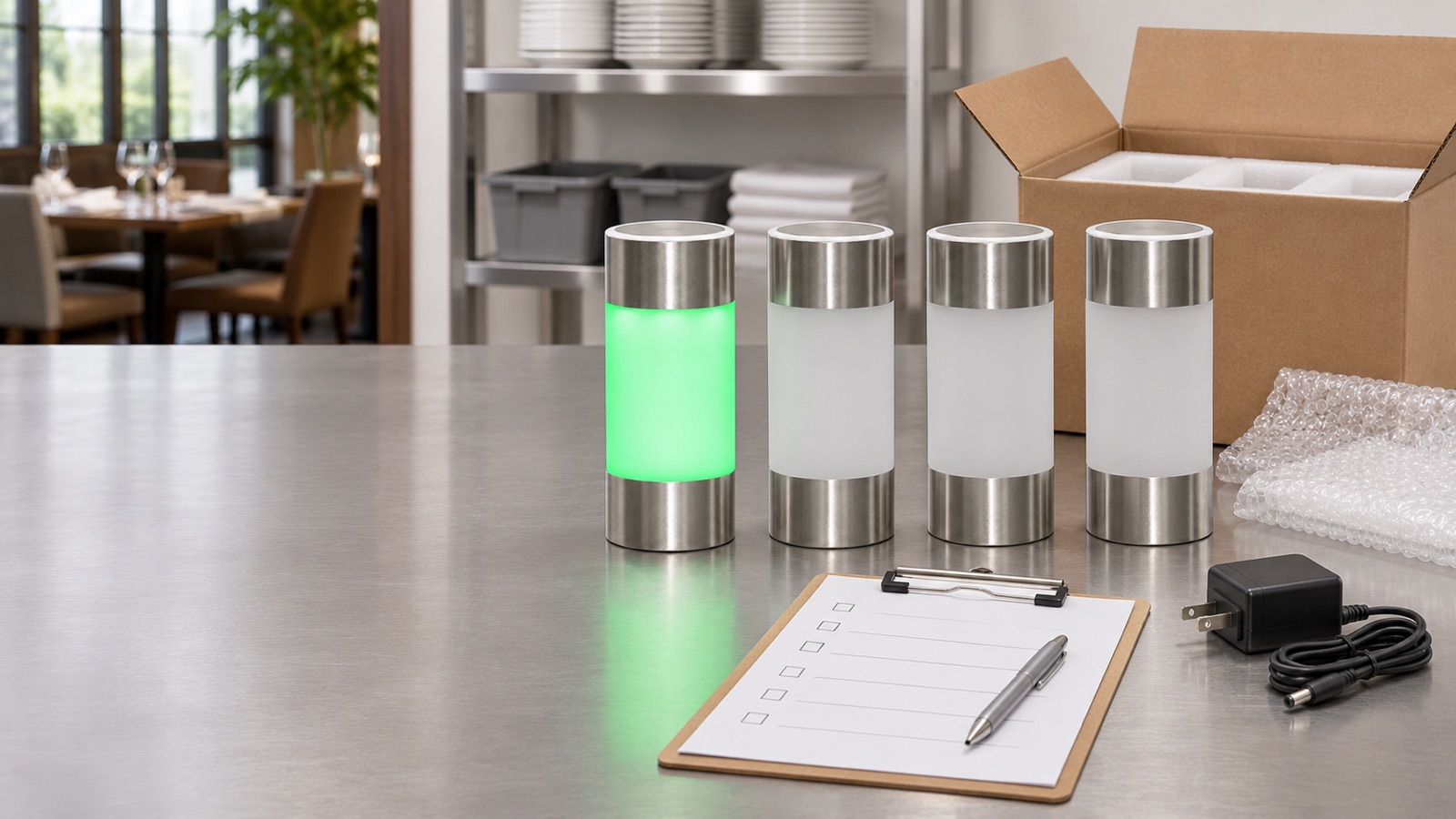
A restaurant should inspect a bulk delivery of rechargeable table lamps before the lamps enter guest service. Start by reconciling cartons and ordered components, then confirm product identity, finish, visible condition, controls, charging compatibility and packaging against the purchase order and approved reference. Separate any questionable unit, record evidence and obtain a disposition instead of mixing it with accepted stock. A receiving inspection does not replace factory testing, pre-shipment inspection or model-specific compliance evidence; it confirms that the delivered order matches what the buyer agreed to receive.
Why receiving inspection is different from pre-shipment inspection
Pre-shipment inspection happens before release from the supplier or origin warehouse. Receiving inspection happens after transport, customs handling and final delivery. The two checks answer different questions.
| Control point | Main question | Typical evidence | Decision |
|---|---|---|---|
| Factory testing | Did production complete the defined factory checks? | Controlled production or test record | Continue, contain or rework |
| Pre-shipment inspection | Does the sampled finished lot match the approved order before release? | Inspection report, photos and defect record | Release, rework, sort or reinspect |
| Receiving inspection | Did the correct goods arrive in acceptable condition and match the purchase order? | Receiving count, photos, serial or batch references and hold log | Accept, hold, claim or request supplier direction |
| Commissioning | Are accepted lamps ready for the venue's actual workflow? | Charging, functional and deployment record | Put into service or keep on hold |
A clean pre-shipment report cannot prove that every carton arrived undamaged. A receiving photograph cannot prove electrical safety or battery capacity. Keep each record tied to the decision it actually supports.
Prepare the inspection before the shipment arrives
The easiest time to define acceptance is before production and shipping. Procurement, operations and the supplier should agree which documents and physical references will control the receiving check. If the team waits until cartons are open, staff may not know whether a different plug, finish or accessory is an approved revision or a mistake.
Prepare one receiving pack with:
- purchase order and final itemized quotation;
- approved model, finish and configuration;
- approved sample or controlled reference photos where applicable;
- carton count, units per carton and expected total quantity;
- packing list and destination-specific labels;
- list of included lamps, adapters, charging bases, racks, cables and instructions;
- agreed inspection plan and defect definitions;
- contact for supplier disposition and transport-damage claims;
- a clean hold area that keeps unapproved units out of service.
Do not convert a marketing image into a dimensional or color standard. A controlled sample can help with appearance and operation, but written specifications are still needed for labels, accessories, packaging, electrical input and order-specific revisions.
Step 1: control the delivery before opening cartons
Record the carrier, arrival date, delivery reference and visible carton condition. Photograph crushed corners, water marks, punctures, broken seals or missing labels before opening. Follow the carrier's claim procedure.
Count cartons against the packing list. Check the destination, purchase order and agreed carton identifiers. Do not assume similar cartons contain the same lamp. Separate different finishes, plugs or charging configurations before sampling.
Use a dry, adequately lit receiving area and prevent inspected, uninspected and held units from mixing. Keep packing materials until the first condition review is complete.
Step 2: verify product identity and order configuration
Open cartons from different locations in the delivery, not only the easiest carton at the top. Compare the product, inner box and master carton with the itemized order. The purpose is to detect mixed models, finishes, accessories or packaging versions before the entire shipment is distributed.
Verify the fields that apply to the order:
- supplier model and buyer SKU;
- ordered finish and visible color state;
- buyer logo or unbranded version;
- instruction language and destination label;
- regional plug and adapter;
- charging base, rack or cable type;
- quantity per inner box and master carton;
- approved packaging revision;
- any agreed table number, barcode or asset label;
- included documents and accessories.
For JBTD-137, the current public product information identifies a 2600 mAh battery capacity, 0.6 W rated lamp power and 12 V DC / 0.3 A input per lamp. It also describes a specified 12 V DC / 10 A / 120 W adapter for a matching shared configuration of up to 25 lamps. These values help identify the proposed configuration. They do not prove runtime, charging duration, battery chemistry, certification or acceptance of the delivered shipment.
Step 3: inspect appearance and construction consistently
Appearance checks should use the same lighting, viewing distance and reference for every sampled unit. Restaurant lamps are repeated across many tables, so small variations can become more visible as a group than as a single product.
Review exposed surfaces for:
- scratches, dents, stains, corrosion or adhesive residue;
- inconsistent finish color, gloss, grain or texture;
- sharp edges, loose trim or visible gaps;
- tilted assemblies or uneven joints;
- unstable standing position on a flat surface;
- damaged diffuser surfaces or visible contamination;
- mismatched logo position or print quality where branding was ordered;
- charging contacts, ports or connectors that appear bent, blocked or contaminated.
Define critical, major and minor defects before inspection. Do not invent acceptance limits after seeing the result. If a formal sampling plan is used, its inspection level, AQL, defect classes and acceptance numbers must be agreed and applied correctly. ISO 2859-1 provides AQL-indexed schemes for lot-by-lot inspection by attributes, but citing it alone does not establish the correct plan for this purchase.
Step 4: perform limited functional checks without creating unsupported conclusions
A receiving function check confirms agreed user-facing behavior. It does not replace laboratory safety testing, battery validation or a full runtime test.
For a sampled lamp, follow the model instructions and record:
- whether the lamp switches on and off as expected;
- whether each agreed control mode can be selected;
- whether light output is visibly stable during the short check;
- whether the physical control responds consistently;
- whether the lamp seats correctly in its matching charging position;
- whether the supplied adapter and connection match the order;
- whether any unusual odor, heat, sound, swelling or visible damage is present.
Stop using and isolate a unit if the instructions, supplier or site safety process require it. Do not open the lamp, bypass controls, substitute an unapproved power supply or improvise a water test. A lamp that turns on once has passed only that limited observation. It has not demonstrated rated capacity, service runtime, charging time, lifecycle or compliance.
For the JBTD-137 visual-service function, the public description identifies green as the normal dining state and red as a local visual service-request state. If that configuration is part of the order, receiving staff can confirm the visible state change on sampled units. This does not verify a radio network, app, receiver or electronic waiter-call system; those are different system claims.
Step 5: check charging equipment as a matched system
Lamps, charging positions, adapters and cords should be checked as one ordered configuration. A physically similar connector is not proof of compatibility. Match model references, electrical ratings, plug type and supported positions to the approved quotation and instructions.
Use a component reconciliation table:
| Ordered item | What receiving staff confirm | What remains a supplier or qualified-test question |
|---|---|---|
| Complete lamp | Correct model, finish, visible condition and limited operation | Battery performance, compliance evidence and lifecycle |
| Charging position | Correct physical type and fit with the ordered lamp | Long-duration charging behavior and formal safety testing |
| Adapter | Ordered model, label, plug and condition | Suitability outside the documented configuration |
| Cable or lead | Correct quantity, connector and visible condition | Use with unlisted adapters or extensions |
| Shared charging setup | Correct number of positions and matched components | Capacity under any configuration not documented by the supplier |
For JBTD-137, “up to 25 lamps” applies only to the matching shared configuration with the specified 12 V DC / 10 A / 120 W adapter. It is not permission to attach any 25 lamps, use a different adapter or combine unrelated charging parts. Record the actual component references received.
Step 6: reconcile packaging, labels and venue-ready quantities
Inspect packaging for both product protection and order accuracy.
Check:
- inner supports hold the lamp without avoidable movement;
- exposed surfaces have the agreed protective material;
- accessories are separated from finished surfaces where required;
- cartons are dry and free from crushing that may affect the product;
- quantity and model labels match the contents;
- buyer barcode, SKU or carton mark matches the approved data;
- instruction and caution documents are present where specified;
Count venue-ready complete lamps separately from units on hold, missing components, spare adapters and charging accessories. The spare-lamp planning guide explains why a complete ready lamp cannot be replaced in the count by a loose adapter or unverified part.
Step 7: classify findings and prevent accidental use
Every questionable unit needs a visible status. Use simple categories that operations can understand:
- Accepted: the receiving checks are complete and no unresolved finding blocks commissioning.
- Hold for review: the unit requires supplier, procurement or safety review.
- Transport claim: evidence suggests delivery damage and the carrier process is open.
- Missing or incorrect component: the lamp or accessory does not match the order.
- Rework or replacement pending: a written disposition has been agreed but not completed.
Do not place held units with accepted stock. Record carton, model, finish, visible finding, photo reference, quantity and owner. “Does not switch on during the receiving check” is an observation; “battery failure” requires evidence.
Step 8: decide acceptance, containment and supplier follow-up
A receiving inspection should end with a documented decision, not an informal collection of photographs. Reconcile:
- total ordered quantity;
- total delivered quantity;
- accepted complete lamps;
- lamps and accessories on hold;
- missing or incorrect items;
- transport-damage cases;
- supplier disposition and due date;
- revised quantity available for commissioning.
If findings exceed the agreed plan or suggest a repeated issue, pause distribution and ask whether sorting, rework, replacement or reinspection is required. Acceptance sampling is a lot decision tool, not a guarantee that every uninspected unit is defect-free. For a critical safety concern or unclear electrical condition, follow the applicable site procedure and obtain qualified guidance.
Keep decisions with the receiving record. If local rework is authorized, define who may perform it, the instructions and the verification method.
Step 9: commission accepted lamps for restaurant use
Receiving acceptance does not mean a lamp is ready for a table. Commissioning prepares accepted units for the venue's operating system.
The commissioning record can include:
- venue asset or table-zone identifier;
- initial visible condition;
- correct model and finish;
- matched charging location;
- completion of the instructed initial charge or setup;
- confirmation of agreed control states;
- cleaning preparation using the approved care method;
- assignment to active, ready-reserve or event stock;
- date and person responsible for release to service.
Use the commercial lamp cleaning and maintenance guide to separate routine care from receiving acceptance. Use the runtime testing guide if the buyer still needs a controlled sample test for the planned brightness and service window. Receiving inspection should not generate a runtime claim from a short power-on check.
A practical receiving checklist for restaurant buyers
Before closing the delivery record, confirm:
- [ ] delivery and carton condition recorded before opening;
- [ ] carton count reconciled to the packing list;
- [ ] model, finish and packaging revision match the order;
- [ ] buyer labels and instruction language are correct where specified;
- [ ] lamps, adapters, charging positions and cables are counted separately;
- [ ] regional plugs and adapter references match the approved configuration;
- [ ] sampled units checked under consistent appearance conditions;
- [ ] agreed controls and visible states checked on the sample;
- [ ] no unsupported runtime, battery or certification conclusion added;
- [ ] findings classified with photos and carton references;
- [ ] held units physically separated from accepted stock;
- [ ] supplier or carrier disposition recorded where needed;
- [ ] accepted quantity reconciled before commissioning;
- [ ] commissioning owner and charging location assigned;
- [ ] records retained with the purchase order and approval package.
Questions to put in the RFQ before the next order
A receiving problem often begins with an incomplete purchase description. Add these questions to the next commercial lamp RFQ:
- Which model, finish and revision will appear on the product and cartons?
- What lamps, adapters, charging equipment, cables and documents are included?
- Which destination plug and instruction language apply?
- What approved sample, drawings or photos control appearance?
- Which checks are performed on every unit and which are sampled?
- What defect categories and sampling plan apply before shipment?
- What pre-shipment evidence will the buyer receive?
- How should transport damage and receiving discrepancies be reported?
- What storage, initial charging and commissioning instructions apply?
- Who authorizes rework, replacement or release of held units?
FAQ
Should a restaurant inspect every delivered lamp?
Count and identify the whole delivery, then apply the written inspection plan. Some checks may be required for every unit, while detailed appearance or functional checks may use an agreed sample. The correct scope depends on risk, order terms and the selected model.
Is an AQL sample the same as checking product safety?
No. AQL-based sampling supports lot acceptance decisions for defined attributes. It does not replace applicable safety standards, laboratory tests, certifications or model-specific compliance documents.
Does a pre-shipment inspection remove the need for receiving inspection?
No. Receiving confirms the delivered count, identity, condition and order configuration after transport. It also captures carrier damage or mixed accessories that may not have been visible before shipment.
Can staff test a lamp with any adapter that fits?
No. Use only the documented matching equipment and instructions. Physical fit does not prove electrical compatibility. For JBTD-137, confirm the exact lamp and shared charging configuration stated in the current quotation.
Does a lamp turning on mean the battery passed?
No. It confirms a limited function at that moment. It does not establish capacity, runtime, charge duration, lifecycle or safety. Use controlled testing and applicable evidence for those questions.
What should happen to a lamp with a cosmetic defect?
Record the location, severity, quantity and reference photos, then classify it using the agreed defect definitions. Keep the unit on hold until the buyer and supplier provide a documented disposition.
How long should receiving records be kept?
Use the buyer's quality, warranty, legal and supplier-management requirements. At minimum, keep enough information to connect findings and decisions to the purchase order, shipment, carton group and product configuration.
Conclusion
A useful receiving inspection confirms that the right lamps and charging components arrived, identifies discrepancies before deployment and creates a controlled path for held units. Compare the delivery with the purchase order and approved reference, not with an assumption based on appearance.
For JBTD-137, preserve the verified model values and matching charging condition exactly. Do not turn a short receiving check into unsupported claims about runtime, battery chemistry, certification or service life. Finish the process by reconciling accepted quantities and commissioning only the units that have a clear release status.
Send your requirements to Jbian.
Send your table-lamp order and receiving requirements to Jbian. Share the model, quantity, finish, destination plug, charging configuration, packaging and inspection expectations so the quotation can itemize the physical scope and open evidence questions before production.