OEM vs ODM Rechargeable Table Lamps: A Buyer’s Sample Approval Checklist
A practical buyer-side workflow for turning a rechargeable table-lamp concept into a documented, reviewable order.

Quick answer: define ownership, configuration and approval before the first sample
An OEM or ODM rechargeable table-lamp project is easier to control when the buyer defines four things before sampling: the target market and use case, which design decisions belong to the buyer or supplier, the exact sample configuration, and the evidence required to approve production. A sample that looks right is not automatically a production specification. Record its model, revision, components, finish, labels, packaging and acceptance criteria, then require written change approval if any of those items change.
For a hospitality lamp, the review may need to cover more than appearance. Buyers should test the guest interaction, light state, charging method, cleanability, packaging and documentation for the destination market. No general OEM/ODM checklist can establish that JBTD or any specific supplier offers a particular customization, certification or lead time; those are project-specific items to confirm in the quotation.
Introduction: turn a design idea into an orderable product
Private-label buyers often begin with a reference photo, a competing model, or a broad request such as “make a cordless lamp for restaurants.” That is enough to start a conversation, but not enough to release a reliable purchase order. Two teams may interpret “same color,” “long runtime,” “water-resistant,” “custom logo” or “ready for the US” differently. The gap becomes expensive when packaging, samples, tooling or compliance documents are already in motion.
OEM and ODM are used differently by suppliers, so agree on responsibilities rather than arguing about labels. In a common OEM arrangement, the buyer supplies a defined design or specification and the manufacturer makes it. In a common ODM arrangement, the supplier contributes a design or platform and the buyer selects or requests agreed adaptations. Real projects can combine both patterns. Ask who owns the drawings, who approves component substitutions, which documents cover the final configuration and what the supplier is actually committing to deliver.
This guide provides a practical sequence from project brief to sample approval and first bulk order. It is written for importers, hospitality distributors, restaurant groups and lighting brands evaluating rechargeable table lamps. It does not claim undocumented factory results; it describes a buyer-side control process that can be applied to a specific supplier and model.
OEM vs ODM: compare decision rights, not labels
| Topic | Typical OEM emphasis | Typical ODM emphasis | What the buyer should record |
|---|---|---|---|
| Starting point | Buyer-controlled design or detailed specification | Supplier platform or supplier-assisted design | Reference version and what may be changed |
| Design authority | Buyer generally defines key requirements | Shared decisions; supplier may contribute design | Named approver for each decision |
| Tooling or artwork | May be buyer-provided or project-specific | May rely on supplier platform or new adaptation | Ownership, access, reuse and maintenance terms |
| Product evidence | Buyer asks how its design is validated | Buyer asks which evidence belongs to the base and modified version | Exact model/revision and document scope |
| Brand and packaging | Buyer artwork applied to agreed product | Brand integrated with agreed adapted product | Approved logo files, labels, languages and packaging samples |
| Main project risk | Supplier interprets or substitutes a buyer requirement | Buyer assumes a platform is exclusive or fully validated | Written exclusions, change rules and approval record |
These are common commercial patterns, not legal definitions. The signed contract and project documents determine each party’s obligations. A supplier’s use of “ODM” does not, by itself, prove exclusive design ownership or a particular level of engineering support.

Stage 1: prepare a useful product brief
The first brief should communicate the job the lamp needs to do. Include where it will be sold, who will use it, where it will sit, how it will be charged, and what existing alternatives it must fit beside. A restaurant-table product, a hotel bedside lamp and a bar service-cue lamp may share a rechargeable format but have different requirements for light direction, handling, cleaning, table footprint, signal meaning and packaging.
Separate requirements into three groups:
- Must have: conditions that would make the product unsuitable if not met, such as a specific user interaction, a plug version for the destination, a non-negotiable envelope, or a required document.
- Preferred: features that improve the offer but can be traded off, such as an optional finish or accessory.
- Open for review: items where the buyer needs the supplier to propose an option or test method.
For every measurable requirement, give a method or reference. “Small base” is unclear; a maximum footprint with a drawing is testable. “Long battery life” is not a test condition; the buyer should specify brightness, color mode, operating cycle and acceptance threshold. If the final threshold is not known, mark it as an open point and ask for a sample evaluation plan instead of treating it as an agreed claim.
Annotate reference files: images show visual direction, not material grade or internal construction; sketches show intended dimensions, not electrical performance. Label what each file controls and who approves changes.
Stage 2: check supplier and platform fit
Before paying for a custom sample, establish whether the project begins from an existing model, a modified platform or a new design. Ask the supplier to identify the proposed model and configuration, show which features are standard versus project-specific, and list the work that requires a separate engineering or tooling quote. Do not assume a photo of a similar product proves that the same battery, charger, material, finish or user function is included.
A fit review should address:
- Intended use and indoor/outdoor exposure. Do not infer an ingress-protection rating from a covered-terrace photo.
- Lamp behavior, controls, color states and how guests or staff will understand them.
- Charging input, adapter, charging base and plug versions for the destination market.
- Target dimensions, mounting or placement constraints, stability and handling needs.
- Surface finish, color reference, cleaning method and packaging protection.
- Required market documents and which exact model or component each document covers.
- Spare parts, warranty terms, minimum order, sample charges and planning lead times, all stated as commercial terms to confirm.
Ask for a feasibility response that distinguishes “available as standard,” “possible subject to sample or engineering review,” and “not confirmed.” This gives the buyer a controlled scope and discourages an unverified capability from silently turning into a purchase-order assumption.
Stage 3: quote the complete configuration
A comparable quotation should describe a complete sellable configuration, not a bare lamp with important accessories left implicit. The quote should identify the product model, included charging equipment, adapter specification, destination plug, finish, branding, packaging and any manuals or labels. It should state quantity assumptions, sample terms, MOQ, price validity, payment terms, delivery basis, estimated timing and exclusions.
Compare quotes line by line. A lower unit price may omit chargers, branded packaging, compliance documents, spare parts or testing. Ask whether costs include engineering, artwork, tooling, sample freight and post-approval changes; record commercial terms in writing.
For a product-specific example, the JBTD-137 product page lists 2600 mAh per lamp, 0.6 W rated lamp power, 12 V DC / 0.3 A charging input and a specified 12 V DC / 10 A / 120 W adapter for a matching configuration of up to 25 lamps. Those facts apply to that documented model configuration only. They are not a generic promise for other lamps or a customization offer. Confirm the exact ordered rack, adapter and included components in the quotation.
Stage 4: request and control the sample
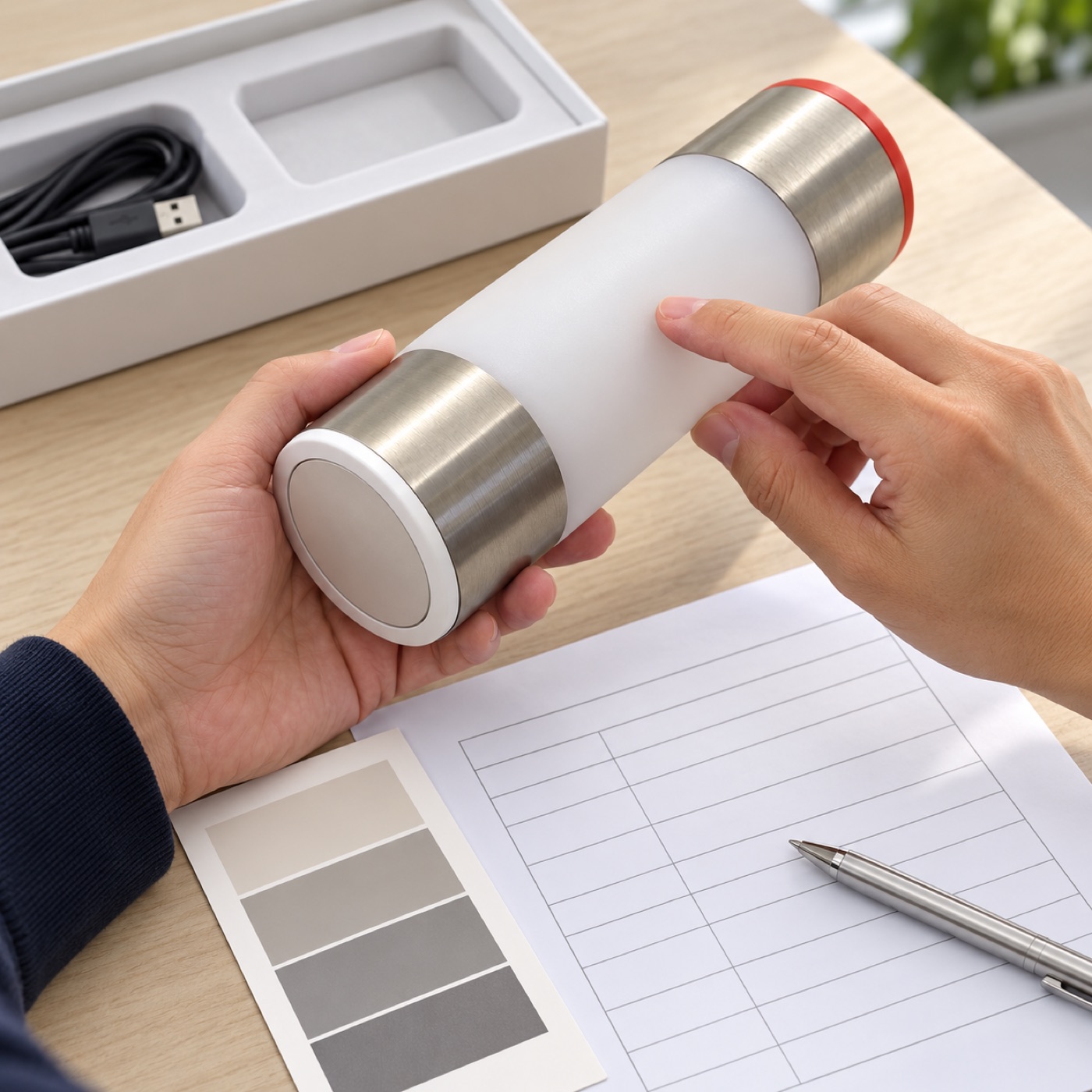
A sample should answer a decision. State whether it is an appearance sample, functional sample, engineering sample, pre-production sample or final approval sample. List the features being reviewed and the features that are not yet representative. If the buyer expects a custom logo or market label, do not assume a plain sample demonstrates those deliverables.
Record the sample identity on arrival: supplier, model, revision, date received, battery/charger configuration, finish, accessories, label version and packaging. Photograph the sample and keep the supplier’s written configuration alongside it. If a sample is a one-off prototype with parts that will change, mark those differences instead of using it as a master without qualification.
Run a review against the brief. For a rechargeable hospitality lamp, a buyer may examine:
- Appearance and workmanship: finish consistency, visible gaps, edges, surface marks, label placement and the approved color reference.
- Function: switch behavior, dimming or service cue if applicable, and whether a first-time user can understand the control.
- Charging: fit on the intended base, adapter label, connection behavior and the documented charging procedure. A short check does not establish full charge time or cycle life.
- Use environment: handling, table placement, stability, cleaning routine and visibility under the buyer’s actual light conditions.
- Packaging: product restraint, accessory count, protection, carton markings and language files.
- Documents: consistency between model identifiers on the sample, labels, specification sheet, reports and quotation.
If a result fails, describe the condition and evidence. “The finish looks wrong” is less actionable than a photograph beside the approved color reference and a note naming the surface. Ask the supplier to identify root cause, proposed correction and whether the revised sample changes a component or document.
Stage 5: approve a controlled reference
A golden sample is useful only when the buyer and supplier agree what it represents. Record the model and revision, approved artwork, physical color or finish reference, accessories, label and packaging revision, functional behavior and permitted deviations. Keep the signed approval or email acceptance with the specification. If several variants are involved, identify each with a part number or unique configuration label rather than using one photo for all versions.
Set change control before production. The supplier should notify the buyer before substituting a battery, LED, charger, material, finish process, packaging component or factory where the change can affect requirements. The buyer should decide whether the change requires a new document review, sample or test. A “same performance” statement is not enough when the component or test evidence is tied to a specific model.
List unresolved items in the approval record. Name the owner and decide whether production may begin before pending reports, labels or carton proofs are complete.
Stage 6: plan production checks and shipment inspection
Agree the pre-shipment inspection scope before production: lot, sampling method, defects, measurements, function, accessories, labels, packaging and pass/fail handling. The method depends on order risk and the quality agreement; there is no universal sampling number.
For lamps, link each inspection item to the approved specification. Check the sample from the finished production lot against the approved reference, not only against a supplier’s catalog image. Verify that the production model, adapter, charging base, logo, manual and carton correspond to the purchase order. If battery paperwork is required for shipping, verify that it identifies the relevant battery type or product configuration; do not infer compliance from the fact that a unit powered on during inspection.
Agree who may release shipment. If an independent inspector is used, provide the current revision of the checklist and clear acceptance rules. If the buyer or supplier handles the inspection internally, record date, lot, results, nonconformities and corrective action. A signed report does not replace applicable market compliance or transport documentation.
Buyer checklist before issuing a purchase order
Use this checklist as a final gate. Mark each item approved, not applicable or still open.
- Product model, revision and complete bill of materials are identified.
- Intended use, market and user requirements are written.
- Standard features and custom changes are separated.
- Sample purpose, test method, acceptance criteria and approval authority are recorded.
- Approved artwork, labels, manual language and packaging files are revision-controlled.
- Required compliance documents are matched to the ordered model and market.
- Charging base, adapter, plug version and spare accessories are itemized.
- MOQ, sample charges, tooling, unit pricing, validity, payment, delivery basis and timing are written.
- Permitted substitutions and change-notification rules are agreed.
- Production inspection scope, nonconformity process and shipment-release authority are defined.
- After-sales contact, warranty period, exclusions and replacement procedure are stated in the contract or order record.
The checklist is not a certification list or legal contract. It is a way to identify gaps early enough to resolve them before production.
FAQs
What is the difference between OEM and ODM table lamps?
In common usage, OEM means production to a buyer-defined design or specification, while ODM involves a supplier-provided platform or greater supplier design contribution. Suppliers use these terms differently. Define ownership, scope, approvals and documentation in writing.
Should I approve a sample before placing a bulk order?
For a new or modified product, a representative sample review is a practical way to confirm appearance, controls, accessories, packaging and documentation. The sample must be tied to a model and revision, and the order should state how production will be checked against it.
What is a golden sample?
It is the buyer-approved physical reference for a defined model and revision. It should be accompanied by specifications, artwork, accessory list, functional requirements and permitted deviations. A sample without configuration records can be difficult to use as an acceptance standard.
Does the JBTD-137 support private-label customization?
The model evidence in this guide confirms product specifications and current web materials but does not establish specific customization scope, MOQ, tooling, pricing or timing. Ask Jbian to confirm which logo, finish, packaging or configuration options can be offered for your quantity and market.
What should I send for an OEM/ODM quotation?
Send the target market, use case, reference images or drawing, must-have dimensions or functions, quantity range, preferred finish, branding needs, packaging language, compliance requirements and target review date. Label unconfirmed values as targets rather than final specifications.
How do I verify that documents match my sample?
Compare manufacturer, model, revision, battery or adapter identifier and configuration on the document with the approved product. Ask the supplier to explain scope and any exclusions. When legal interpretation or market eligibility is involved, confirm with the responsible compliance professional or authority.
What does a pre-shipment inspection prove?
It records whether the inspected lot met the agreed inspection scope at the time of inspection. It does not automatically establish long-term reliability, compliance with every destination-market rule, or performance outside the sampled conditions.
Conclusion: make the approval record part of the product
A successful private-label project is controlled by the link between a clear brief, a feasible configuration, a representative approved sample, revision-controlled documents and defined production checks. Review the current Jbian OEM/ODM information and quality-control information, then confirm the exact scope in your project quotation. The terms OEM and ODM are only shorthand; the important details are who owns decisions, what exactly is being made and what evidence is required before shipment.
Start with requirements and market scope, request a line-item quotation, test the sample against written criteria, and record any changes before releasing volume. That process helps buyers compare suppliers fairly and reduces the chance that the delivered lamp differs from the approved reference.
Send your requirements to Jbian.
Send Jbian your OEM/ODM brief with your target market, product reference, quantity range and must-have requirements. Request a model-specific scope, sample plan and quotation with open points clearly listed.