USB-C vs DC vs Wireless Charging for Commercial Table Lamps
A buyer-focused guide to connector labels, complete charging systems, peak-return capacity and sample checks—without assuming that cordless use means wireless charging.
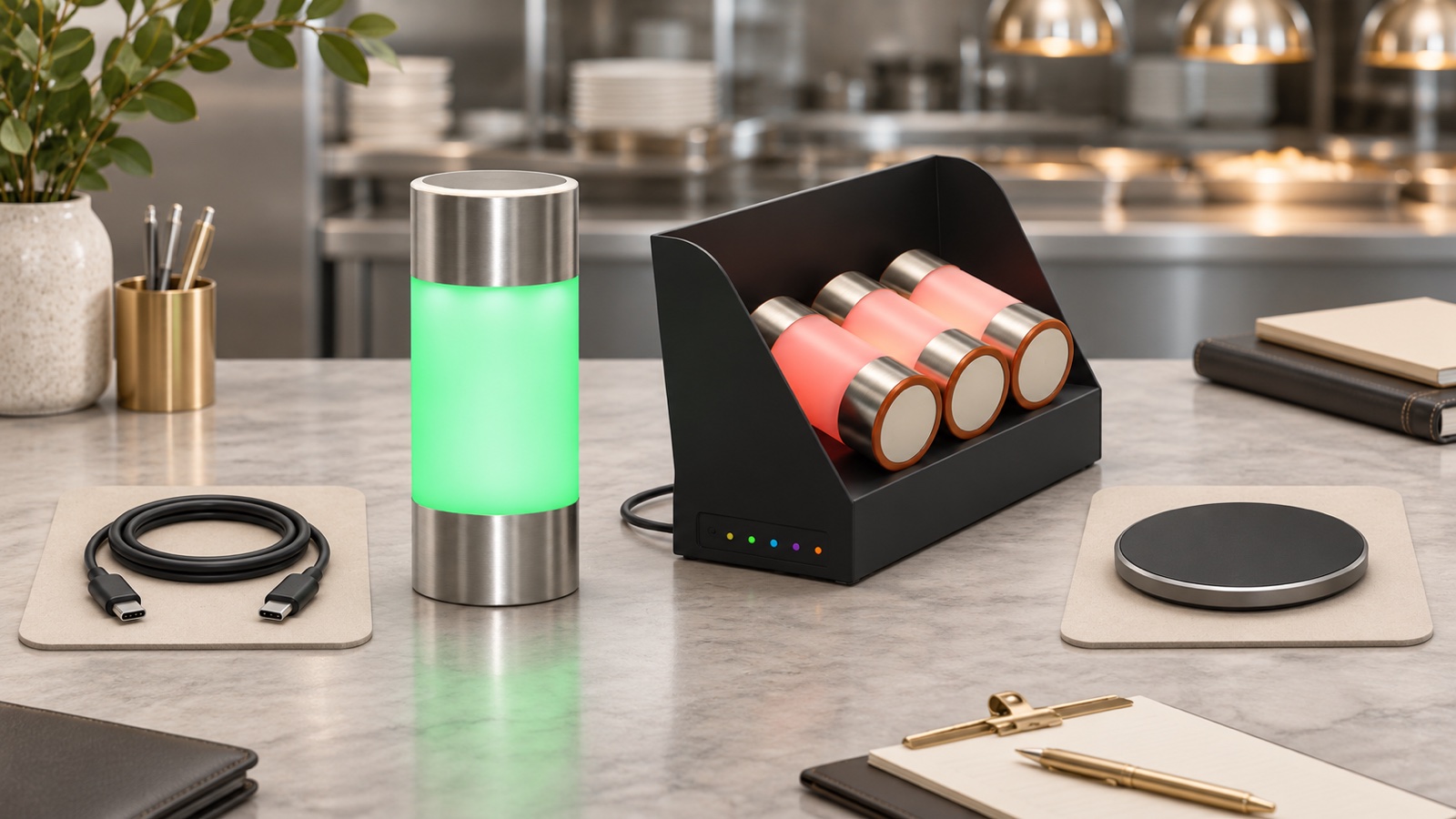
Quick answer: cordless does not describe the charging method
A cordless table lamp has no power cable connected while it is being used. That description does not tell a buyer how the lamp recharges. A commercial rechargeable lamp may use an individual USB-C connector, a model-specific DC input, a contact dock, a shared rack or a true inductive wireless system. These methods are not interchangeable, even when the products look similar.
For a restaurant, hotel or distributor, the best method supports the complete workflow: peak lamp return, charging window, staff handling, storage, destination plug, replacement accessories and documented electrical configuration.
USB-C is a connector type, not proof of a particular charging speed or USB Power Delivery capability. The USB-IF language guidance states that USB Type-C and USB Power Delivery are not interchangeable terms. Likewise, a product should not be described as Qi Certified merely because it charges without a cable. The Wireless Power Consortium certification process includes compliance and interoperability testing for products that receive Qi certification.
The procurement question is: “Which exact lamp-and-charger system can be documented, tested and operated consistently at our required scale?”
Define the charging terms before comparing quotations
Charging language is often inconsistent across product listings. A buyer should define each term in the RFQ and require the supplier to identify the exact interface on the quoted model.
Cordless or wireless lamp
“Cordless” and “wireless lamp” usually describe battery-powered use without a mains cable attached. Neither proves inductive wireless charging. The lamp may still require a cable, barrel connector, charging pin or contact base.
USB-C charging
USB-C describes a reversible connector form. It does not state the supported voltage, current, protocol, adapter, cable or charging duration. Request the lamp input, cable, power source, supported power behavior and simultaneous unit count.
Avoid writing “USB-C means any charger will work.” Connector fit is not a complete compatibility test. The lamp, cable and source must match the documented implementation.
DC input and shared DC system
A DC input uses a stated direct-current voltage and current for the product. The physical connection may be a barrel plug, fixed lead, proprietary contact, rack or another matched interface. The buyer must confirm voltage, current, polarity where relevant, connector or contact arrangement, adapter rating and the maximum number of positions supported by the quoted configuration.
A larger adapter rating does not automatically authorize more lamps. Use only the capacity established for the matching rack, wiring, connectors and instructions.
Contact dock, magnetic contact or pogo-pin base
Some lamps charge through conductive contacts instead of an inserted plug. This is still contact-based charging. Ask about alignment, indication, approved contact care, orientation and incorrectly seated units.
Do not call a contact dock “wireless charging” unless the supplier clearly distinguishes the marketing wording from the actual power-transfer method.
True inductive wireless charging
Inductive charging transfers power without a direct conductive connection between the transmitter and receiver. The buyer should confirm the exact standard, transmitter, receiver, positioning requirements, foreign-object behavior, status indication and certification evidence claimed for the finished product.
If Qi certification is claimed, verify the exact product and certificate in the WPC database. Do not transfer certification from a component, phone charger or similar model to the quoted lamp.
USB-C vs DC vs contact dock vs wireless charging
| Charging approach | What it identifies | What the buyer must verify | Typical workflow question |
|---|---|---|---|
| Individual USB-C connection | A connector type on each lamp | Input rating, supported power behavior, cable, adapter, hub capacity and exact model compatibility | How many separate cable insertions are required at peak return? |
| Individual DC connector | A model-specific DC input | Voltage, current, connector, polarity where relevant, adapter and replacement source | Can staff identify and use only the matched adapter? |
| Shared DC rack or base | A central adapter and multi-position charging arrangement | Exact lamp, rack, position count, power distribution, adapter, plug and instructions | Can all returned lamps be seated, counted and checked within the charging window? |
| Contact dock or magnetic contacts | Conductive contact charging without plugging a cable into the lamp | Alignment, contact care, orientation, indication, dock compatibility and spare dock policy | How will staff find a lamp that was placed incorrectly? |
| Inductive wireless system | Power transfer without conductive contacts | Standard, certified transmitter and receiver, alignment, status indication and finished-product evidence | Does every quoted lamp work with every quoted charging position under the agreed conditions? |
This table is a procurement map, not a universal performance ranking. Charge duration, energy use, heat, service life and failure rate depend on the exact product and test conditions. Request evidence instead of assigning a result to a connector category.
Compare the complete charging system, not one port
Count every component in the quotation
A quotation should identify the lamp, charging base or rack, adapter, mains lead, destination plug, cables, replaceable accessories and instructions. If an item is not included, mark it as excluded. This prevents a low lamp unit price from hiding the cost or operational impact of missing charging equipment.
For USB-C, record cables and power sources. For a shared rack, record supported positions and the adapter. For inductive charging, record transmitter and receiver details. A photograph is not a shipment scope.
Map the peak return, not the average day
Charging capacity should be based on the largest group of lamps that returns together. A restaurant may collect most table lamps after closing, while a hotel may have several smaller return periods. Record the number of lamps in service, the number returned at peak, the charging window and the number of usable positions.
When peak return exceeds confirmed positions, use a documented rotation plan, additional matched equipment or a different arrangement. Do not add unapproved splitters or adapters.
The multi-lamp charging capacity guide explains how to separate lamp count, simultaneous positions and operating margin. Use that method after the charging interface is identified.
Count staff touches and exception handling
The number of physical actions can affect consistency. Individual cables may require one insertion per lamp. A rack may require each lamp to be placed in a defined orientation. A contact or inductive pad may appear simple but still needs correct alignment and a visible confirmation state.
During a representative sample test, time collection, approved wipe-down, placement, connection, status check, fault isolation, removal and redeployment. Record missed connections and ambiguous indicators before making labor claims.
Evaluate USB-C charging as a commercial system
USB-C may be familiar to staff, but its usefulness depends on the exact implementation and operating rules.
Ask the supplier to state:
- the precise input rating of the lamp;
- whether the product implements USB Power Delivery or another supported power behavior;
- the cable type and rating supplied with each lamp or charging set;
- whether a mains adapter or hub is included;
- how many lamps the proposed source can support at the same time;
- the destination plug and any regional power requirements;
- the charging indicator sequence and error state;
- the approved replacement cable and power-source specification.
Inspect receptacle position, staff handling, cable routing and approved care. A familiar cable does not establish ingress protection or permission for liquid exposure.
USB-C is not a synonym for “fast charging.” The lamp and source must support any advertised behavior, with stated test conditions.
Evaluate a matched DC multi-lamp system
A shared DC system can organize many units around one specified adapter and charging structure. Its value depends on the matching parts and the way operators use them.
For the JBTD-137 rechargeable flip table lamp, JB’s published product data identify a 12 V DC / 0.3 A charging input per lamp and a specified 12 V DC / 10 A / 120 W adapter for the matching shared configuration of up to 25 lamps. These figures apply only to that documented configuration. They do not authorize connecting 25 lamps to an arbitrary adapter, rack or cable.
The JBTD-137 information reviewed for this guide does not claim USB-C charging, Qi charging, a verified charge duration or universal compatibility with other racks. It also does not establish annual energy use from the input label alone. Those points must remain open until supported by the exact quotation and current documents.
When reviewing a shared system, request:
- Model and revision of every lamp and rack.
- Number of supported positions in the quoted configuration.
- Adapter input and output information and destination plug.
- A clear diagram or photograph showing how each lamp connects.
- Charging and fault indication for each position.
- Instructions for loading, unloading, storage and contact care.
- Replacement policy for adapter, lead, rack and related parts.
- A sample test using the proposed quantity and current production configuration.
The “up to” position count should be treated as a configuration limit, not a promise that every venue should buy that quantity. Match the charging system to the fleet plan and peak return.
Evaluate contact and inductive charging without marketing shortcuts
Inspect contact alignment and condition
For conductive contacts, test correct and slightly incorrect placement, visible indication and the documented correction process. Use only the approved care method.
Record lamp and dock model identifiers. Similar diameter or contact patterns do not prove compatibility.
Verify a wireless charging claim
For an inductive system, request the exact certification or test evidence named in the quotation. The WPC states that Qi certification requires compliance and interoperability testing before certification is granted. Buyers can use the WPC product database when a Qi Certified claim is made.
Avoid three common errors:
- calling any cable-free dock “Qi” without evidence;
- treating a Qi-certified transmitter component as proof that the complete lamp is certified;
- assuming a wireless pad intended for another device will support the lamp.
Name the finished lamp, receiver, transmitter, relevant revision, power source and permitted alignment. If Qi certification is not claimed, use the actual documented method.
Use a controlled sample test before selecting the interface
The charging method should be tested with the actual lamp, actual charger and realistic staff routine. A useful buyer-side test does not require the supplier to claim results that have not been measured.
Prepare the test
Freeze the sample and charging equipment. Record identifiers, adapter label, cable or rack revision, plug and instructions. Define lamp count, return window, staff role and acceptable indication.
Run the workflow
Have representative staff collect and place the lamps after service. Record connection errors, loose fit, awkward routing, incorrect orientation and missing indications.
If charging duration or runtime is a purchase criterion, use a separate agreed test with a defined starting condition, lamp state, environment and end criterion. A short connection check proves only that the tested unit showed the documented response at that moment.
Review failure handling
Define how staff isolate, store and report an unresponsive lamp, cable, dock or position without using unapproved substitutes.
Use the pilot guide for restaurant lamps to connect this charging test with table placement, service use, cleaning and redeployment.
Put charging requirements into the RFQ and inspection plan
Charging details should appear in the RFQ before sample approval, then carry through the purchase order, approved sample and shipment inspection.
Include these fields:
- lamp model, revision and quantity;
- charging method described in technical terms;
- per-lamp input information;
- charger, rack, dock, cable and adapter model or specification;
- simultaneous supported positions;
- included quantities and explicit exclusions;
- mains input and destination plug;
- status-indicator behavior;
- required certification or test evidence for specific claims;
- sample-test method and acceptance record;
- packaging arrangement for lamps and charging components;
- replacement-part identification;
- shipment inspection checks for model, quantity, function, accessories and labels.
At shipment inspection, compare the production configuration with the approved sample and documents. Check that the right charging accessories and plug version are packed, and perform only the function checks defined in the inspection plan. Do not replace a qualification test with a quick power-on observation.
The commercial rechargeable lamp RFQ checklist provides the wider quotation structure. Add the interface-specific fields above so suppliers cannot answer “USB,” “wireless” or “charging rack” without defining the actual system.
Buyer decision checklist
Before selecting USB-C, DC, contact-dock or inductive charging, confirm:
- Do we know the exact power-transfer method rather than a marketing label?
- Is the lamp input documented for the exact quoted model?
- Are all charging components, quantities and exclusions listed?
- Does the proposed system cover the peak number of returning lamps?
- Can staff connect or place every lamp consistently?
- Is the charge or error indication visible and understandable?
- Are the destination plug and mains requirements confirmed?
- Are replacement cables, adapters, docks or racks identifiable?
- Are claimed USB, USB Power Delivery or Qi capabilities supported by appropriate evidence?
- Has the complete sample workflow been tested and recorded?
- Does the shipment inspection verify the same approved configuration?
- Are runtime and charging-duration claims tied to defined conditions?
If any answer is missing, keep it as an open requirement. Do not fill the gap with a category assumption.
FAQ: commercial table lamp charging methods
Does cordless mean the lamp charges wirelessly?
No. Cordless describes battery-powered use without a cable attached during service. The lamp may recharge through USB-C, a DC connector, conductive contacts, a shared rack or an inductive system. Confirm the exact method for the quoted model.
Is every USB-C table lamp compatible with USB Power Delivery?
No. USB-IF guidance distinguishes USB Type-C from USB Power Delivery. Ask the supplier to state the supported power behavior, lamp input, cable and source. Do not infer capability from the connector shape.
Is a magnetic charging base the same as wireless charging?
Not necessarily. A magnetic base may use conductive contacts held in alignment by magnets. That is different from inductive power transfer. Ask for a diagram and technical description.
Can a Qi phone charging pad charge a wireless table lamp?
Only if the finished products are documented as compatible. If Qi certification is claimed, verify the exact products and certificate through the Wireless Power Consortium.
Which charging method is fastest?
The interface name cannot answer that. Request a model-specific value and test method, then verify it during sample evaluation.
Which method is best for a restaurant fleet?
Choose the documented system that covers peak return, charging window, staff workflow, storage and replacement. Test the complete configuration.
Does JBTD-137 use USB-C or Qi charging?
The public JB information reviewed for this article states 12 V DC / 0.3 A input per lamp and a specified 12 V DC / 10 A / 120 W adapter for a matching shared setup of up to 25 lamps. It does not state USB-C or Qi charging. Confirm the current rack, adapter, plug and included parts in the quotation.
Can I mix charging racks and adapters from different suppliers?
Do not mix components based only on connector fit or a similar rating. Use the exact matched system documented for the lamp, or obtain written technical confirmation and appropriate testing for the proposed combination.
Conclusion: specify the system, then test the workflow
USB-C, DC, contact and inductive charging describe different systems. Compare the exact lamp input, components, simultaneous positions, plug, staff handling, indication, replacement path and certification evidence.
For JBTD-137, the verified starting point is a model-specific DC configuration: 12 V DC / 0.3 A per lamp and a specified 12 V DC / 10 A / 120 W adapter for the matching shared setup of up to 25 lamps. Keep USB-C, Qi, charge duration, runtime and cross-system compatibility out of the specification unless current evidence supports them.
Send your requirements to Jbian.
Ask Jbian for the current JBTD-137 charging configuration and an itemized quotation. Send your destination, lamp quantity, peak return, charging window, plug requirement and preferred operating workflow. Jbian can identify the proposed lamp, rack and adapter scope and record the questions that still require confirmation.