
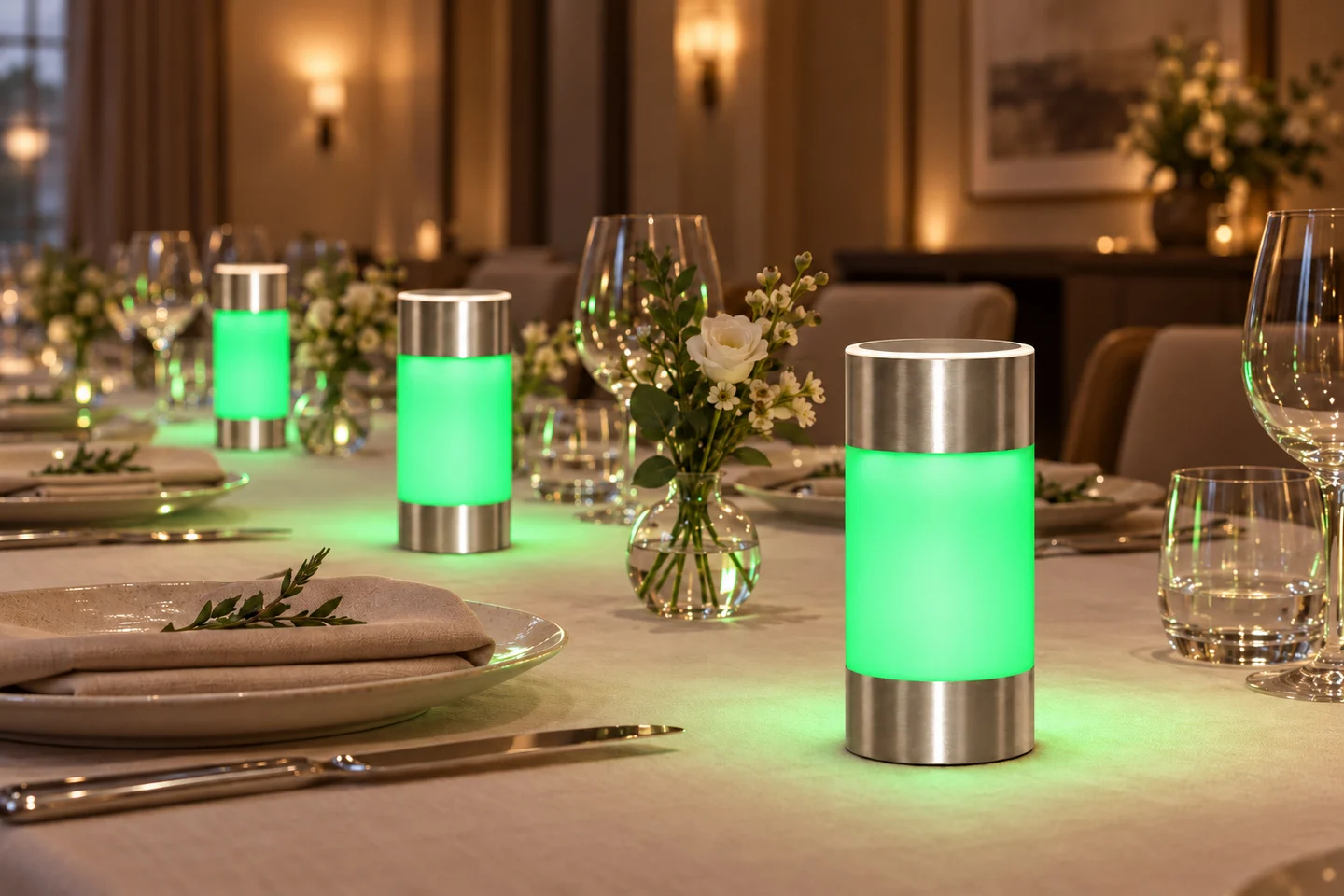
For restaurant and hotel procurement, cordless table lamp runtime should mean useful light throughout the service period, at the brightness guests actually need. Before approving a bulk order, test representative samples at your intended setting, record light levels over time, and confirm that the lamps can recharge within your operating schedule. A headline battery-life figure alone cannot establish whether a lamp will cover dinner service or support consecutive events.
This guide provides a practical buyer-designed acceptance workflow. It is not a report of Jbian laboratory results, a certification procedure, or a claim about any particular model. Use it to agree on customer requirements with your supplier before sampling, then translate the approved results into production and shipment inspection criteria.
Why the advertised runtime may not match your restaurant
Battery runtime depends on the operating conditions behind the number. A lamp described as lasting a full evening may have been measured at minimum brightness, while your tables need a brighter setting. Another model may continue glowing for hours after its output becomes unsuitable for reading a menu. Both figures can describe battery operation without answering your purchasing question.
Manufacturer documentation illustrates why the setting matters. NEMO's Portofino product page lists different battery durations for maximum, medium, and low output. That is evidence for requesting setting-specific information, not a performance benchmark for Jbian products or every rechargeable lamp. Compare the exact models and document revisions offered in your quotation.
Ask what ends the manufacturer's test: automatic shutdown, a defined light-output threshold, or another condition. Also confirm ambient conditions, battery configuration, charging method, and whether accessory features were active. If these details are absent, treat the advertised figure as an initial screening point and request a reproducible sample test.
Define the service period before choosing the lamp
Include preparation, service, and closing time
Write down when staff switch the lamps on and when they return them for charging. Include table preparation, early arrivals, extended bookings, and the period after the kitchen closes. A six-hour reservation window does not necessarily equal six hours of lamp use. Keep separate requirements for ordinary dinner service, all-day hotel lounges, and private events.
For an illustrative venue, lamps might switch on at 17:00 and return to storage at midnight. That creates a seven-hour operating requirement before any contingency allowance. If procurement chooses an extra hour for overruns, the acceptance target becomes eight hours. This is a planning example, not a recommended universal margin or a product specification.
Agree on useful light, not just visible light
Set up a representative table with the intended menu, table finish, glassware, and surrounding lighting. Agree on a brightness setting that supports the application without uncomfortable glare. Have the operations team approve it before starting endurance tests. Changing the dimmer halfway through a test makes comparisons difficult and can conceal an unsuitable initial selection.
Record the selected setting and a repeatable measurement position. A buyer may use a lux meter to compare illumination at a marked point on the table. This does not replace laboratory photometry or prove compliance with lighting requirements. It provides a consistent field check when the geometry, background light, instrument, and procedure remain unchanged.
Build a sample test sheet that another person can repeat
Identify each sample individually rather than recording only a model name. Request samples that represent the proposed production configuration, including battery, driver, charging base, adapter, and firmware where applicable. For private-label orders, confirm that a later cosmetic or electronic change will not invalidate approval. Keep the supplier's configuration confirmation with the test record.
The test sheet should capture the following information for every unit:
- Sample identifier, model, configuration revision, and date received.
- Battery voltage and capacity as documented by the supplier.
- Charger and adapter identifiers, with relevant input and output ratings.
- Starting charge condition and the manufacturer's charging instructions.
- Brightness setting, selected light color, and enabled extra functions.
- Room conditions, table arrangement, meter position, and background lighting.
- Start time, timed observations, useful-light endpoint, and shutdown time.
- Recharge start, charge-complete indication, and next-service readiness.
Choose the sample quantity and repeat count with the supplier according to order risk. One unit can reveal a mismatch, but it cannot establish consistency across a production lot. Do not describe a small informal sample exercise as statistical proof of reliability. Larger or higher-consequence projects may need a formally agreed inspection plan and independent laboratory support.
Run the test from full charge to the agreed endpoint
1. Prepare the samples consistently
Follow the manufacturer's initial charging procedure using the specified accessories. Confirm what the charge indicator means and whether the lamp should remain off during charging. Do not improvise a different adapter to accelerate the process. Check for visible damage, loose components, unstable bases, and incomplete instructions before including a unit in the comparison.
Use a dry, suitable testing and charging location within the manufacturer's operating limits. If there is unusual heating, swelling, odor, leakage, or damage, stop using the affected unit and follow the supplier's safety instructions. A procurement endurance check should never involve opening a battery pack, defeating protective controls, or testing beyond stated conditions.
2. Fix the setting and measurement geometry
Place each lamp at the same measured distance from the observation point. Mark both positions so accidental movement is obvious. Set the agreed dimming level and light color, then record the starting reading. Keep room lighting stable; changing daylight can otherwise make a falling battery output appear constant, or create the opposite impression.
3. Record useful output at planned intervals
Choose an observation interval appropriate to the service period, such as hourly checks with closer observations near the expected endpoint. Record the actual times rather than assuming every interval was exact. Note flicker, unexpected resets, changes in color appearance, or brightness steps. Include operational observations such as touch-control usability and whether the lamps remain stable during table service.
4. Separate useful runtime from shutdown runtime
Stop the useful-runtime clock when the lamp no longer meets the agreed application criterion, even if it still emits light. Record shutdown separately if the manufacturer's instructions permit continuing the test. This distinction helps prevent a misleading comparison between a lamp that maintains adequate output and one that runs longer at an unusably low level.
5. Recharge and repeat under the same conditions
After the run, follow the manufacturer's recharge instructions and repeat the process as agreed. Compare individual units and repeated runs, not just a single best result. A repeated shortfall is a reason to investigate the setting, charging procedure, sample configuration, or suitability of the model before approving production. Preserve the original readings when a test is repeated.
Compare samples with an operational decision table
The following comparison uses hypothetical observations to show the decision process. These are not measured results, supplier claims, or recommendations for specific products. In this example, the buyer has chosen an eight-hour useful-light target and has six hours available for recharging.
Buyer criterion
Sample A, hypothetical
Sample B, hypothetical
Purchasing implication
Useful runtime at approved setting
8.5 hours
7 hours
Only A meets the example service target
Time until shutdown
10 hours
11 hours
Shutdown alone would favor the wrong sample
Recharge time under agreed conditions
5 hours
7 hours
B also exceeds the example charging window
Output consistency across samples
Requires verification
Requires verification
Do not infer consistency from one unit
Investigate why a result differs before rejecting or approving a whole product family. A different approved setting might suit another venue, while a different battery or driver configuration may require new samples. Do not silently lower the light requirement to make the purchase pass. Any change should be accepted by the people responsible for the guest experience.
Send your service requirements before sampling
Share your operating hours, target quantity, intended brightness, charging window, and destination market with Jbian. Include whether the project needs standard products or private-label development. Send Your Requirements to discuss a sample configuration and the information needed for your acceptance checklist. Model-specific performance should be confirmed in the quotation and sample documentation.
Send inquiryCheck the charging workflow as carefully as the battery
An acceptable lamp can still fail operationally if there are too few charging positions or staff cannot identify incomplete charging. Count the lamps that must be ready for the next service, the available compatible charging positions, and the time available. Confirm whether the quoted recharge duration applies with all positions occupied and the actual adapter configuration in use.
If a hypothetical restaurant has 60 lamps and only 30 compatible charging positions, at least two batches are needed when every lamp requires charging. Staff must transfer the second batch at the right time. Overnight storage does not automatically create a workable two-batch workflow. Assess staffing, collection time, charging indication, and the consequences of a missed transfer.
During installation preparation, plan dry storage, suitable access, cable management, and the electrical supply with the responsible facilities team. Follow equipment instructions and local requirements. Do not assume a lamp's outdoor rating also applies to its charger. For system planning, explore Jbian's multi-lamp charging solutions and ask which accessories are compatible with the quoted lamp.
Record how staff distinguish ready, charging, and unavailable units. A simple labeled storage process can prevent partially charged lamps returning to tables. Trial the collection and placement workflow with normal service staff; a neat demonstration by a salesperson may not reveal the handling constraints of a busy restaurant.
Turn sample approval into production and shipment checks
Specify what the approved sample represents
An approved appearance sample should not automatically become approval for every electronic configuration. Link the purchase specification to the exact model revision and documented battery, driver, and charging accessories. Agree on how substitutions will be disclosed and reapproved. Keep dated photographs and identifying labels so the reference is usable during factory testing and shipment inspection.
Distinguish performance screening from safety assessment
Your runtime checklist addresses whether the lamp supports an operating task. It does not establish electrical safety or regulatory compliance. The IEC description of IEC 60598-2-4 identifies its scope as portable general-purpose luminaires. Ask the supplier and an appropriate testing specialist which standards, editions, and market requirements apply to the exact lamp and accessories being purchased.
Request documents that identify the actual product configuration. A general factory certificate or a report for a different model does not answer a model-specific question. Avoid treating a successful evening of operation as evidence that batteries, adapters, or outdoor use have been independently certified.
Agree on inspection records and exceptions
Before production, specify which units will receive runtime checks, the agreed setting and endpoint, the inspection sampling approach, and how failures are handled. Full-duration checks take time; include them in the production schedule instead of discovering the requirement at dispatch. Define who can approve a deviation and what corrective evidence is needed.
Shipment inspection can check identifiers, accessory completeness, packaging condition, and records against the approved configuration. It should not be presented as proof of full runtime unless the agreed endurance test was actually performed. Jbian's quality-control page is a starting point for discussing the evidence your order requires; confirm the final inspection scope in writing.
Questions to include in your request for quotation
Ask suppliers to quote against the same operating brief. Specify useful runtime at an agreed setting, intended charging method, daily service schedule, quantity, market, and relevant environmental conditions. Request model-specific specifications and instructions rather than relying on a brochure headline. This makes differences in price and configuration easier to interpret.
Also ask about battery service arrangements, compatible replacement accessories, warranty terms, and how future configuration changes are communicated. Do not assume the battery is user-replaceable or that a warranty promises unchanged capacity throughout its duration. Obtain the actual policy and assess whether the replacement process fits your venue's maintenance capability.
For a broader view of material, light quality, and application choices, read the commercial cordless table lamp buying guide. Use that guide to shortlist products, then use this runtime workflow to establish an acceptance basis for the shortlisted configuration.
FAQ
How many hours should a restaurant table lamp last?
It should meet your full switch-on period at an approved brightness, plus any contingency you choose for your operation. There is no single duration appropriate for every venue. Specify actual service hours and test the shortlisted model against them.
Does a larger mAh number guarantee longer runtime?
No. Capacity alone does not describe the complete lamp. Battery voltage, usable energy, operating power, controls, and selected brightness affect the comparison. Request the battery configuration and measured runtime conditions; compare samples at equivalent useful illumination rather than ranking them by mAh alone.
Can we estimate runtime from watt-hours?
Dividing usable battery energy in watt-hours by average battery-side power in watts provides a rough planning estimate in hours. Nameplate capacity and LED-rated power may not represent those quantities. Conversion losses, control behavior, and cutoff conditions make sample testing necessary before a purchasing commitment.
Should we test maximum brightness or the restaurant setting?
Test the approved service setting for the main acceptance decision. A separate maximum-output run may help characterize another use case, but keep the records distinct. If guests or staff can change the setting during service, account for that behavior in the operating plan.
Can lamps stay on while charging?
Only use that mode if the manufacturer explicitly permits it for the specific configuration. Charging duration and thermal behavior may differ from charging with the lamp off. Do not transfer a published recharge time to a different operating mode without confirmation.
Should the sample results become a bulk-order guarantee?
Use them to agree on written acceptance criteria, inspection scope, and configuration control. A few samples alone do not guarantee every production unit. Define the supplier's commitment and the procedure for nonconforming units in the purchase documentation.
Conclusion: buy a verified service outcome
The useful question is whether a defined lamp configuration can deliver the required table lighting for your service period and become ready again before the next shift. Approve a repeatable test, preserve the readings, and connect the result to charging capacity and production inspection. This creates a clearer purchasing basis than a long headline runtime without test conditions.
Get a Quote for your restaurant or hotel project
Tell Jbian your table count, service hours, destination market, charging arrangements, and customization needs. Get a Quote for a suitable configuration and request the model-specific information needed to plan sampling. You can also explore the product range before preparing your requirements. Confirm performance, accessories, and inspection commitments against the final quoted model.