Cordless vs Wired Table Lamps for Restaurants: What Buyers Should Compare
A venue-level decision framework for comparing movable rechargeable lamps with fixed power-connected lighting.
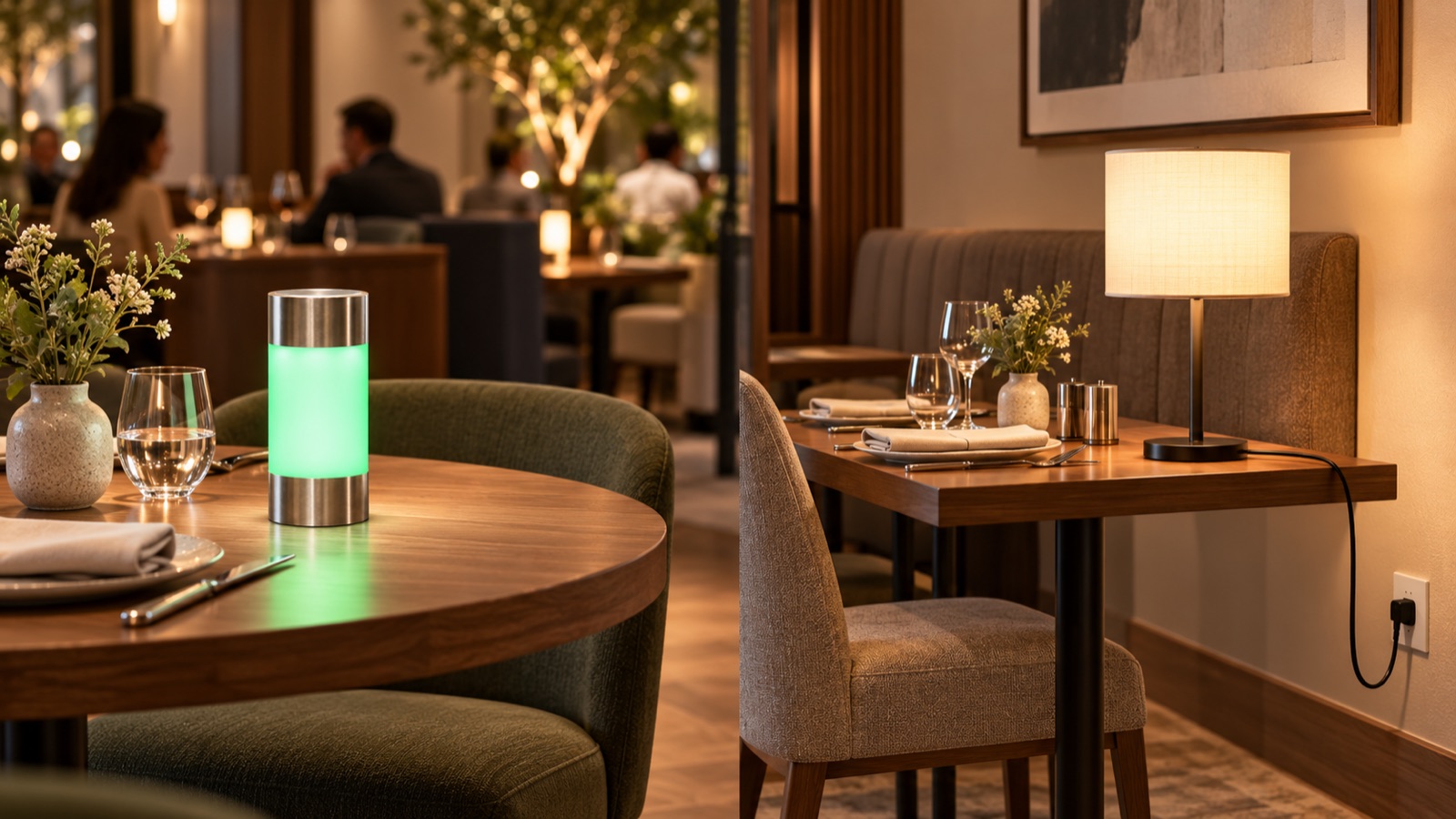
Quick answer: choose the power model that fits the room’s operating pattern
Cordless table lamps are often a practical fit when restaurant tables move, outlets are inconvenient, or the venue wants to change layouts without managing a power cable at every place setting. Wired lamps can make more sense at fixed tables where continuous operation is important and the outlet, cable route and cleaning process are already planned. Neither format is automatically cheaper, safer or more convenient in every venue. Buyers should compare the full workflow: table placement, daily service hours, charging and storage, electrical access, maintenance and the consequences of a lamp being unavailable.
The JBTD-137 is one documented cordless example: it has a 2600 mAh battery, 0.6 W rated lamp power, a specified 12 V DC charging arrangement and a local green/red visual service cue. These specifications do not establish its runtime, charge duration or suitability for every table. Compare the exact product configuration against the wired alternative and the venue’s operating requirements rather than assuming that “cordless” alone resolves them.
Introduction: compare operating systems, not just lamp bodies
For a restaurant group planning a refresh, the first question is not simply whether a cordless model looks better. The power source affects where a table can be set, how staff restore the lamp after service, what must be checked before opening and which components need maintenance. A corded lamp also has an operational pattern: it remains attached to a fixed supply, while a cordless lamp is separated from the charging location during use and must be returned to it later.
Searches such as “cordless vs wired table lamps for restaurants” and “are rechargeable table lamps worth it for a restaurant?” reveal a buyer trying to choose an operating approach, not just a style. The comparison is a research inference based on the wording and commercial context of these questions; it is not a report of search volume or a claim that a Google AI Overview displayed a particular answer. The guide below provides a repeatable way for procurement and operations teams to make the decision together.
A side-by-side comparison for hospitality buyers
| Decision area | Cordless table lamp | Wired table lamp | What to verify before buying |
|---|---|---|---|
| Table placement | Can be moved without unplugging a table-level cable | Usually tied to a planned outlet and cable route | How often tables are moved and where outlets exist |
| Operating continuity | Depends on documented runtime and charging rotation | Can remain powered while connected to a suitable supply | Service length, operating mode and interruption tolerance |
| Daily reset | Collect, inspect, charge and stage lamps | Check placement, plug and cable condition | Staff time, storage and opening responsibilities |
| Back-of-house needs | Requires a safe charging location and compatible equipment | Requires suitable outlets and cable management | Facilities review and applicable local requirements |
| Cleaning workflow | Loose lamps can be removed from the table for cleaning | Cables and fixed positions may affect wiping and access | Approved cleaning method and who handles each item |
| Layout changes | Often easier to relocate within the approved use area | Relocation may require a new power plan | Event, private dining and seasonal layouts |
| Service and replacement | Battery and charging accessories need model-specific support | Supply, switch, cable and light source require support | Parts, warranty, replacement procedure and documents |
This comparison deliberately avoids assigning savings, runtime or reliability to either type. Those outcomes depend on the selected model, venue and the work required to keep the system ready.
When cordless can fit the restaurant workflow
Cordless lighting is worth evaluating when a venue frequently changes the arrangement of tables, uses temporary seating, sets up private dining, or has surfaces that do not have a convenient power point. A portable unit can also simplify a visual plan when the buyer wants each table to have a consistent light without routing a cable over or under movable furniture. These are workflow advantages to test, not a guarantee of lower cost or better guest experience.
The operation must account for the battery and charging cycle. Ask what the confirmed runtime is under the intended brightness or operating mode, how it was measured, what charging equipment is included, how many units one charging setup supports, and which adapter or power supply is required. The JBTD-137 published information reviewed for this article lists up to 25 lamps only with the matching charging configuration and specified adapter. That exact detail should not be generalized to a different rack or model.
Cordless is less suitable when the venue cannot reserve space for charging, has no clear collection and staging routine, or needs uninterrupted operation beyond the documented capability. A lamp count equal to the number of tables may not account for charging, damage or service needs. The buyer should determine the active fleet, reserve and charging plan using the supplier’s confirmed model data. Avoid guessing an extra percentage or promising that a certain battery capacity will last a complete service.
When a wired solution can be the better fit
Wired lamps may suit fixed banquettes, built-in tables, hotel desks, reception counters or other locations where the lamp is intended to stay in one position. Continuous connection can remove the need to collect and recharge a battery-powered table fixture, provided the electrical system and lamp are designed for that installation. A buyer considering a wired product should confirm the product’s electrical specifications, supply requirements, installation method, switching arrangement and market-specific documentation.
Fixed placement may also simplify some operational tasks, but it introduces its own design decisions. Outlet locations, cable length, cable protection, cleaning access and furniture movement all matter. The responsible facilities professional should review the proposed electrical layout against applicable local codes and the product instructions. This article does not prescribe electrical installation methods or replace that review.
Do not assume a wired lamp is automatically safer because it has no battery, or that a cordless lamp is automatically safer because it removes a visible cord. Each configuration has hazards and controls that depend on the actual design and installation. Ask the supplier for applicable instructions and have the venue’s qualified facilities team assess the final use.
Compare the total operating burden
Unit price is only one part of the procurement decision. For a cordless option, include charging bases or adapters, spare units if needed, storage, charging-space preparation, staff collection time, cleaning, battery support and the procedure for faults. For a wired option, include the lamp, electrical work if any, outlet or cable provisions, installation, maintenance access, cable management and the effects of fixed placement on room changes.
Instead of claiming one option is less expensive, create a model-specific comparison over the venue’s intended evaluation period. Use supplier quotations and the venue’s own labor and electricity assumptions. List what is included, what is optional, and what could require additional facilities work. Treat battery replacement, warranty, operating life and energy use as unknown until the supplier provides model-specific facts and the venue chooses the relevant assumptions.
A practical comparison worksheet
Record each of the following for both proposed systems:
- Purchase quantity, unit price, accessory scope, sample fees and delivery terms.
- Installation or charging equipment requirements and the person responsible.
- Normal service hours, table locations and planned furniture changes.
- Time needed to place, connect, collect, clean, charge or reset each unit.
- What happens when a lamp is damaged, unavailable or not ready for the next service.
- Model-specific runtime, charging and electrical claims with their evidence source.
- Warranty, replacement parts, technical support, packaging and compliance documents.
- Any destination-market or project requirements still marked “not confirmed.”
Do not put estimates into the final comparison as if they were measured. If management wants a financial scenario before a trial, label it an assumption and show the input values. Replace estimates with observed values after a venue test.
Test both options in the actual table plan
A showroom comparison can hide practical issues. Review each candidate at a representative small table, a larger table and any fixed service point relevant to the venue. Check that guests can reach controls without disturbing tableware, staff can place the light consistently, and the product does not obstruct a menu or service movement. For a wired candidate, observe the actual cable route and outlet access; for a cordless candidate, trace the movement back to collection and charging.
Agree on the evaluation before the sample arrives. Define who will review appearance, light presentation, comfort, cleaning, charging or electrical readiness, table movement and guest feedback. Use the same conditions for competing candidates where possible. Record the model and configuration, date, chosen settings, observations and any limitations. Do not convert a short trial into a claim of long-term reliability or compliance.
Factory testing and shipment inspection should be discussed as evidence with defined scope. Ask which checks apply to the exact model and production revision, how results are recorded, and whether the report can be shared. A shipment inspection can verify the ordered model, visible condition and accessory count; it does not prove a runtime claim unless that test was actually performed under an agreed method. Avoid representing a general quality page or supplier statement as a test certificate for a specific lamp.
Questions to ask each supplier
For a cordless quote
- What is the exact model, battery configuration and supported operating mode?
- What runtime and charge duration are stated, and under which test conditions?
- Which charging base, adapter, plug and cables are included?
- What is the confirmed capacity of the matched charging configuration?
- What are the permitted cleaning method, storage conditions and operating environment?
- What battery documents, electrical declarations and market-specific records are available?
- What service and replacement arrangements apply to the quoted model?
For a wired quote
- What supply voltage, frequency, power and connector does the model require?
- Is installation performed by the buyer’s contractor, and what documents are supplied?
- What cable length, switch location and mounting arrangement are included?
- How should the cord be protected and cleaned in the proposed furniture layout?
- Which lamps or components are replaceable, and what are the support terms?
- Does the installation require facilities or code review in the destination market?
Ask every supplier to separate confirmed details from options and open points. A clean quotation should identify the exact configuration instead of combining a product image, a generic table lamp specification and an accessory that may not be included.
Build a decision rule that staff can follow
A useful decision is simple enough to explain to purchasing, operations and facilities. For example: choose cordless for a zone only when the venue can support the confirmed battery and charging workflow; choose wired for fixed areas only when the site’s electrical plan and cable management are approved. This is a planning rule, not a universal recommendation. A mixed venue may reasonably use different solutions in different zones.
Make the choice zone by zone. A movable dining area, a fixed hotel lounge and an outdoor patio may each have distinct requirements. Identify the operational owner for collection or maintenance, a place for accessories, and the action staff should take when a unit fails inspection. If the workflow has no owner, procurement has not yet solved the operating problem.
When a pilot or sample trial is complete, keep the approved configuration and evidence with the purchase specification. If a component changes, request an updated specification and assess whether re-approval is required. This applies whether the change concerns a battery, lamp, adapter, cable, control, finish or charging arrangement. The objective is to know what has been bought and how the venue is expected to use it.
FAQs
Are cordless table lamps better than wired lamps for restaurants?
Not in every restaurant. Cordless models can support movable layouts when the venue can manage charging and storage. Wired models can suit fixed positions where a suitable electrical installation is available. Compare the full operating pattern and documented model details.
Do cordless lamps eliminate electrical planning?
No. They move the charging activity to a different location. The buyer still needs to confirm the adapter, charging arrangement, outlet availability, storage and operating instructions. Have the venue’s responsible facilities professional review electrical questions.
Can a cordless lamp run through a double service?
Only if the exact model’s runtime is documented for the operating mode and conditions that match the venue’s needs. Battery capacity alone is not enough to establish runtime. Review the sample and test method with the supplier.
Is a wired lamp lower cost over time?
There is no universal answer. The result depends on product price, installation, energy, maintenance, battery or component replacement, labor and room changes. Compare actual quotes and venue assumptions rather than using a generic cost claim.
Can a restaurant use both formats?
Yes, where the spaces have different operational needs and each installation follows its product instructions. A mixed approach can be evaluated by zone; keep the equipment, training and maintenance requirements clear for staff.
Conclusion: choose by zone and prove the workflow
Cordless and wired table lamps solve different placement and operating problems. Cordless products can make movable layouts easier to manage, but only when runtime, charging, storage and support are confirmed for the exact model. Wired products can suit fixed positions, but outlet access, cable routing, installation and maintenance need planning. The better option is the one the venue can operate consistently with documented product evidence.
For a JBTD-137 comparison, start with its published model details and the matching charging accessories, then request any missing runtime, charging or support information in writing. Test the candidate in a representative zone and compare it with the real wired alternative. Record the assumptions, observations and approved configuration before placing a bulk order.
Send your requirements to Jbian.
Contact Jbian to compare a cordless lamp configuration for your project. Share whether tables are fixed or movable, how long each service runs, the destination market and the planned quantity. Ask for confirmed specifications and accessory scope before making the final comparison.