Cordless Table Lamps vs LED Candles for Restaurants
A practical restaurant buyer comparison of cordless table lamps and LED candles, with model-specific questions and a sample-testing checklist.
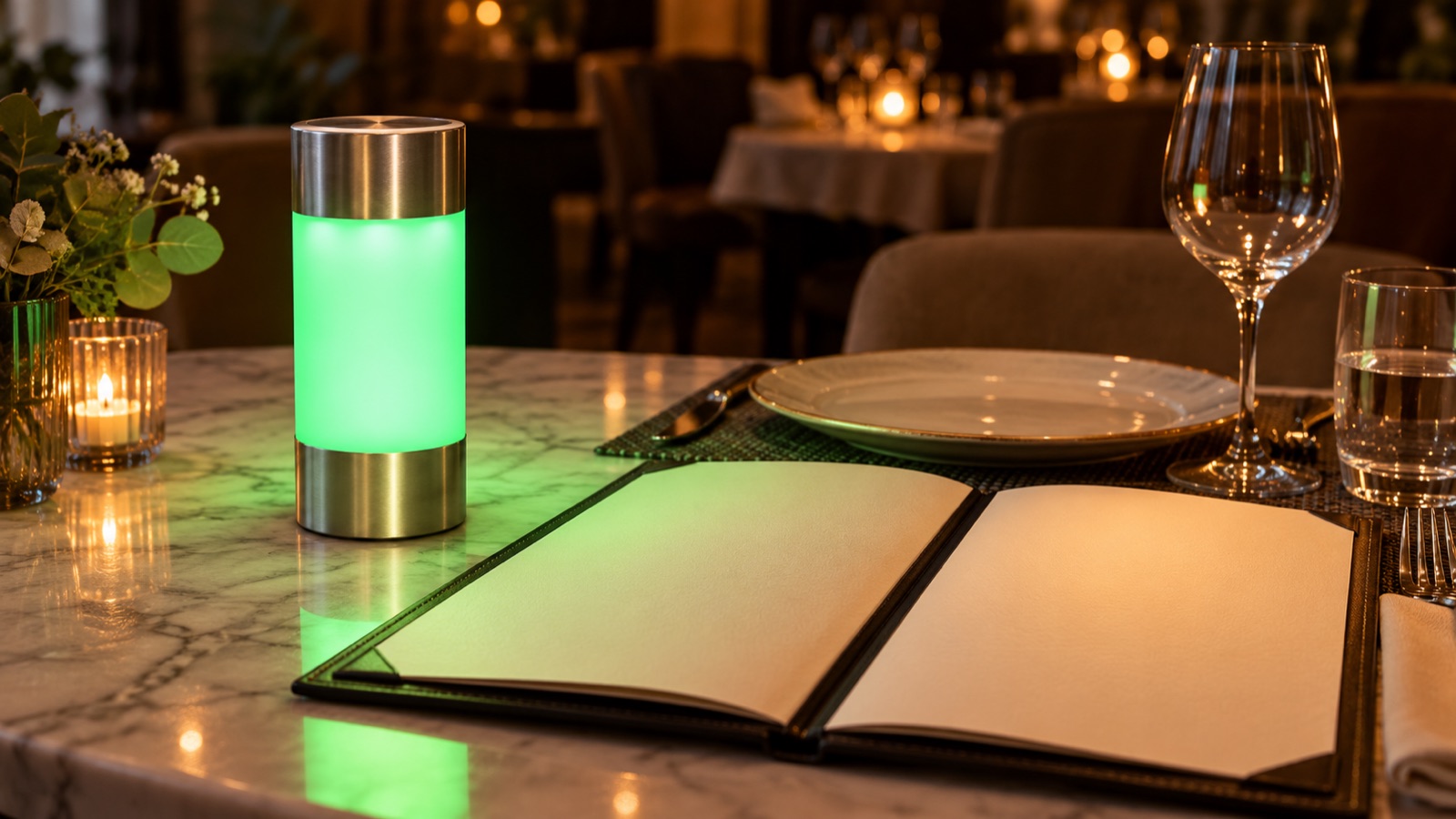
Quick answer: should a restaurant choose cordless table lamps or LED candles?
Choose a cordless table lamp when the venue needs a defined table-level light source, repeatable placement or a product function beyond decoration. Choose an LED candle when the goal is a compact decorative glow and the venue does not need the lamp’s larger form or operating features. Compare actual samples for table footprint, guest comfort, menu use, cleaning, battery handling, charging and replacement cost. Neither category is automatically better; the right choice depends on the role each table setting needs to perform.
The comparison should be about a venue’s job to be done, not an assumption that one product is brighter, safer, longer lasting or less costly. Those outcomes depend on the specific models and their documentation. For example, JBTD-137 is a rechargeable flip table lamp whose product page describes green as normal dining and red as a visual service-request cue. That makes it a different purchase from a simple decorative LED candle, but does not by itself establish the lamp’s measured brightness or suitability for every table.
Introduction: two small products with different jobs
Restaurant buyers often group table lamps and LED candles together because both sit on a table and create a point of light. Operationally, they may solve different problems. A candle-style light can contribute a compact decorative accent. A table lamp can provide a more visible object, a broader light source or a model-specific service feature. But a larger fixture also takes more table space and may need a different return, cleaning and charging routine.
The purchase decision should begin with function. Is the venue trying to create atmosphere, make a menu easier to use, identify a service request, differentiate table zones, or standardize a rechargeable product across locations? If the requirement is only “something warm on each table,” a decorative LED candle may be enough. If staff need a visible customer-operated cue or the venue expects guests to interact with the lamp, examine products designed for that workflow.
This guide compares the categories using questions a procurement team can verify. It does not assume that every lamp has dimming, every LED candle uses the same charging method, or that cordless means waterproof. Product construction, battery, light output, control behavior and compliance evidence vary by model. Ask suppliers for documents that identify the actual item being quoted.
Comparison at a glance
| Buying factor | Cordless table lamp | LED candle | What to verify before ordering |
|---|---|---|---|
| Primary role | Table-level illumination, atmosphere, or model-specific additional function | Decorative candle-like accent | Define the guest or staff task first |
| Table footprint | Usually a more visible vertical object; dimensions vary | Often compact; dimensions vary | Request drawings and test with plates/glassware |
| Menu use | May help in some scenes, but output and distribution vary | May be intended mainly as an accent; model output varies | Test actual menus at the venue |
| Guest interaction | Can include model-specific controls or visual states | Often simple on/off or color modes, depending on model | Confirm exact controls and behavior |
| Charging | May use individual cables, a dock or shared system | Can use replaceable cells, a cable or a multi-unit charger | Compare the exact supplied configuration |
| Cleaning | Requires care instructions for diffuser, finish and interfaces | Requires care instructions for housing and battery access | Request material and chemical guidance |
| Service cue | Some products are designed with a visible service state | Usually not a service call function unless specified | Distinguish visual indication from electronic signaling |
| Replacement planning | Track lamp, charger and compatible parts | Track candle unit, battery or charger parts | Check service and replacement availability |
The table describes common procurement questions, not universal category specifications. Confirm every feature on the model-specific quotation, technical sheet and sample.
Start with the table’s purpose
Before comparing appearance, write down the required function and the conditions that define success. One restaurant may want subtle décor on a small two-top. Another may need a visible indication that a guest wants assistance. A hotel lounge may care more about consistent mood across a large seating area. An outdoor terrace raises separate weather and ingress questions that cannot be answered by the fact that a product is rechargeable.
Use these four decision prompts:
- What should the guest be able to do? Read, signal for service, identify a table, or simply experience an accent light?
- What must staff do? Place, clean, collect, charge, inspect or reset the product between services?
- What evidence is required? Dimensions, light data, battery documentation, care instructions, ingress rating, market-specific compliance or replacement parts?
- What is the table constraint? Small tabletop, shared dishes, menu stands, glassware, accessibility and conversation sightlines?
When answers differ by zone, avoid forcing one product into every setting. A venue could use a decorative accent in one area and a functional table lamp in another, provided staff can identify and manage both configurations. If the business wants one standard SKU, test it against the most demanding actual use case rather than only the easiest table.
Light and menu readability: test, don’t infer
A cordless lamp may be a more useful reading source than a low-profile candle-style accent, but the category name does not guarantee that result. Light output, distribution, color, distance, ambient lighting and menu design all matter. A catalog photo cannot accurately represent the light at a guest’s seat because camera exposure changes the image.
Test both products in the venue with the actual menu, table surface and ambient lighting. Let evaluators sit at normal positions. Ask whether the menu is readable without lifting it, whether reflections or glare are distracting, whether food appearance remains acceptable, and whether the light blocks conversation. Record the table zone and operating mode.
Request lumen output or other photometric data if the supplier has it, along with the measurement basis and model identification. Do not compare a lamp’s wattage with an LED candle’s battery capacity and treat one as an illumination result. For JBTD-137, product materials state 0.6 W rated lamp power and 2600 mAh battery capacity but do not provide public lumen, color-temperature or illuminance data. Those stated values do not prove menu readability.
Guest service: decorative light versus a visual cue
A decorative light and a service-request product do not perform the same role. JBTD-137 product information describes a green state for normal dining and a red state for a service request. The signal is visual and local. Buyers should not describe it as a wireless call system or imply that it alerts a pager, watch, display, mobile app or point-of-sale system unless the purchased configuration includes independently verified equipment that performs that function.
An LED candle usually serves as a visual accent. A buyer considering it for guest requests should establish how a guest signals, how staff recognize the table and what happens if the light is not in the staff member’s line of sight. A table lamp with a visual state still requires a staff workflow: who checks the dining room, whether the state is visible from service stations and how the lamp returns to its normal state. For the difference between a visual cue and a connected alert, see waiter-call lamps versus wireless call systems.
Test from several positions. A red/green distinction may be clear to one observer and blocked by a glass, centerpiece or table divider for another. Confirm the meaning with guests and train staff on the intended behavior. If the venue needs an electronic alert, evaluate a complete compatible call system rather than substituting a visual lamp cue.
Table footprint, placement and guest comfort
The larger visual presence of a table lamp may make its function more apparent, but it can also reduce usable space. A compact LED candle may leave room for shared plates yet be less visible against a bright background. Neither observation is universal; model dimensions and venue layout determine the result.
Request a dimensional drawing for each shortlisted product. Mark the footprint on a sample table with removable tape, then set out the usual plates, glasses, menus, condiments and shared dishes. Check whether servers can place items without moving the light and whether guests can see across the table. Include different table sizes and configurations.
For a sample review, note:
- Product base footprint and overall height from the supplier drawing.
- Space used when the full table setting is present.
- Whether the light blocks sightlines or creates a reflection.
- Whether guests reach across it to use menus or shared dishes.
- How the product behaves when the table is reset or extended.
- The intended storage location between services.
Do not estimate dimensions from a rendered image. Do not choose a product solely because it appears small on a screen; perspective can distort scale.
Charging and back-of-house workload
Charging can influence the total cost and daily workload more than the visible tabletop product. A table lamp may have an individual cable, a matching multi-lamp dock or another charging configuration. LED candles may use replaceable batteries, individual charging or a shared system. Compare the actual order package rather than category assumptions.
Ask each supplier to state how many units a charger is designed to serve, which adapter is included, whether chargers are included in the quotation, and how staff should place units. Confirm regional plug and electrical requirements for the destination market. If the business plans to use a shared charger, obtain the matching configuration in writing; do not pair products based on connector appearance.
For the JBTD-137 listing, the public product materials specify 12 V DC / 0.3 A charging input per lamp and a specified 12 V DC / 10 A / 120 W adapter for a matching shared configuration, described for up to 25 lamps. Verify the exact product and charger configuration against the current quotation. These values are not transferable to a different lamp or an LED candle.
Create a simple daily route: collection, inspection, cleaning, charging, storage and return to service. Estimate staff handling using an actual sample and the proposed charging method. A product that looks inexpensive may require more individual handling; a larger charging setup may need dedicated counter or shelf space. Document the process before comparing prices.
Cleaning and durability: ask for evidence, not adjectives
Tabletop products encounter fingerprints, food splashes, cloths and cleaning chemicals. Ask the supplier for the materials, finishes and care method for every exposed surface. Confirm how to protect battery doors, ports, charging contacts and seams. A table lamp is not automatically easier to clean than an LED candle; either design can have openings or finishes that need specific care.
Do not assume that “metal,” “water-resistant,” “restaurant grade” or “commercial quality” provides a test result. Request a model-specific ingress rating only if one is documented, and request the underlying evidence or report where needed. Ask what cleaning chemicals are permitted, whether a damp cloth is allowed and what condition the product must reach before charging.
For procurement, test the approved routine on a sample using the supplier’s written instruction. Record the cloth, permitted product, visible changes and time required. This is a buyer’s evaluation, not a formal durability test. Do not publish a broad compatibility or service-life claim from a brief trial.
Total cost of ownership: compare complete operating packages
The unit price does not represent the full cost of putting a light on tables. Compare lamps or candles, required chargers, adapters, spare units, replacement parts, storage needs and staff time. If the supplier offers optional accessories, show each line item and whether it is required for the selected configuration.
Use a worksheet with these fields:
- Number of units by table zone and intended function.
- Sample price and production price at the quoted quantity.
- Included charging accessories and regional adapter.
- Replacement or spare components and availability.
- Staff minutes for collect-clean-charge-return steps, measured in a pilot.
- Power and charging requirements from the model documentation.
- Packaging, labeling, documentation and shipment terms.
- Any venue-specific compliance or purchasing requirement.
Do not forecast battery replacement cost or product life unless the supplier provides an applicable warranty or lifecycle basis. If a cost is unknown, keep it as an open item rather than inventing a lifecycle saving. Use comparable quotations with the same unit count, accessory scope and delivery assumptions.
A buyer’s sample test for the two categories
Run a short side-by-side trial only after suppliers provide the correct samples and instructions. Select a representative table and service period. Use the same room state, menu and table setting. Have staff complete the intended sequence: place, use, collect, clean according to the supplied method, charge and return.
Score each product on guest task, visual comfort, footprint, staff handling, cleaning clarity, charging steps, storage fit and documented evidence. Take photos from seated and staff positions. Record sample model, finish, control mode and charger. Share questions with the supplier and keep written answers with the purchase order.
The trial should answer a practical question: which option supports this venue’s intended use with an acceptable level of guest comfort and staff work? It should not be used to claim that one product category is universally safer, brighter, more durable or lower cost.
FAQ: cordless table lamps versus LED candles
Are cordless table lamps brighter than LED candles?
Not as a category rule. Output depends on the exact models and optics. Request comparable photometric information and test both in the venue with the actual menu and ambient lighting.
Are LED candles easier to clean?
That depends on materials, openings, finish and the manufacturer’s care instructions. Ask for model-specific cleaning guidance and evaluate the authorized process on a sample.
Can an LED candle replace a restaurant service-call lamp?
Not unless the product is documented to perform the required service function. A decorative light does not automatically send an alert. A visual color cue also differs from an electronic pager, watch or display system.
Does cordless mean suitable for a patio?
No. Cordless operation does not establish outdoor suitability or an ingress-protection rating. Confirm the exact model’s documented use environment and keep it within the manufacturer’s stated conditions.
Which option takes less space on a small table?
Compare the actual dimension drawings and test each sample alongside the venue’s place settings. Category labels do not establish the footprint of a particular model.
What should a restaurant request with a quotation?
Ask for a model-specific specification, sample configuration, charger and adapter details, care instructions, any relevant test or compliance documents, replacement-part information and a clear list of included accessories. Make sure quoted details match the approved sample.
Conclusion: choose by function, then verify the operating routine
Cordless table lamps and LED candles can both contribute to a restaurant table, but they are not interchangeable by default. Define whether the venue needs menu support, atmosphere, a visible service cue or a compact accent. Then compare real samples for table fit, guest comfort, cleaning, charging and staff handling. Use model-specific specifications for technical comparisons and do not infer brightness, weather resistance or electronic signaling from appearance.
For JBTD-137, the documented product role includes a green normal state and red visual service-request state. Whether that function is useful for your venue depends on staff sightlines and table workflow. The right next step is a sample review tied to your actual seating zones, followed by a quotation that clearly lists the product and charging configuration.
Send your requirements to Jbian.
Send your restaurant table-lighting requirements to Jbian to request current product information and a quotation. Tell us whether your priority is table ambience, menu evaluation, a visual service cue, charging workflow or a combination.