
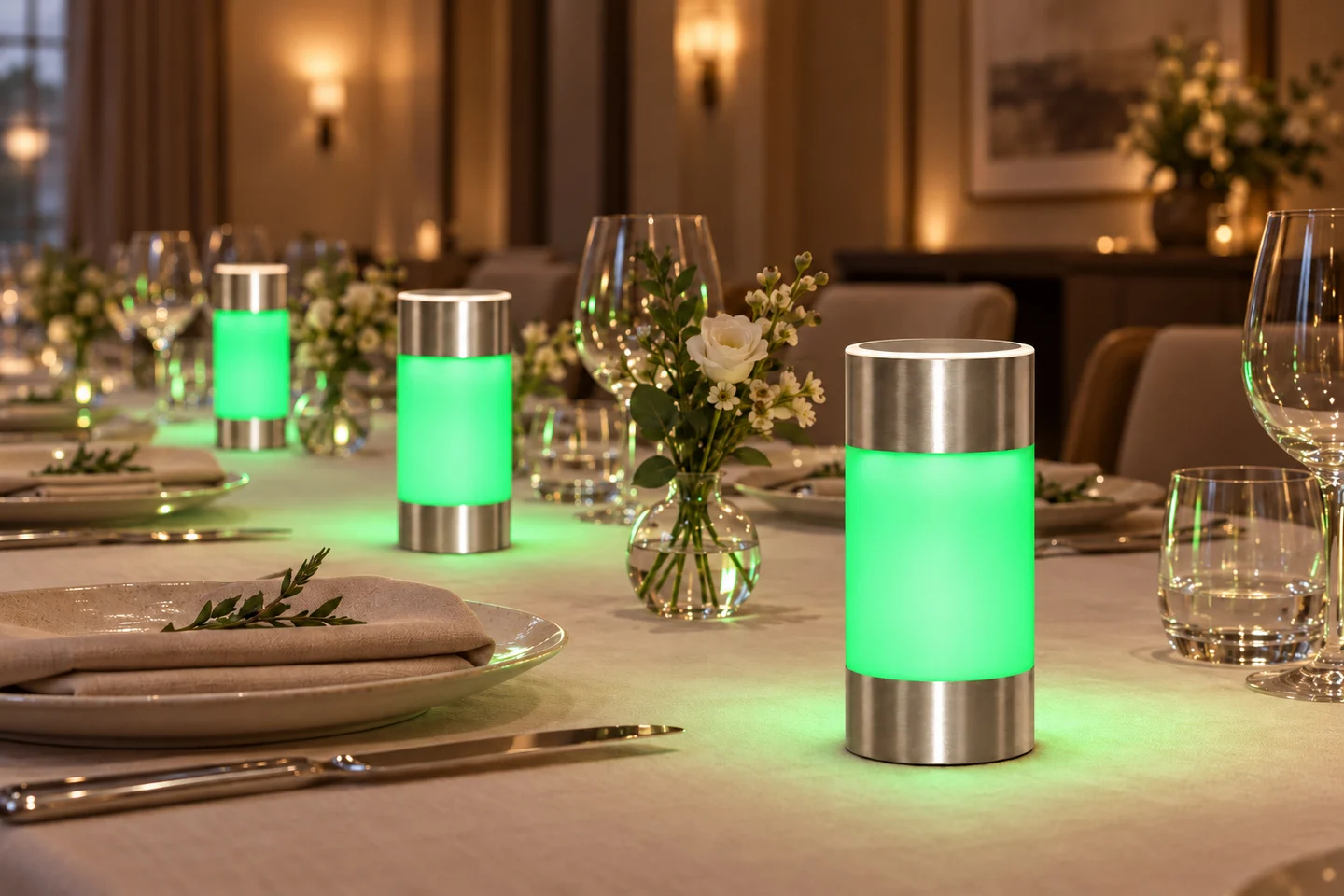
A practical procurement guide to runtime, charging workflow, light quality, materials, IP protection, factory testing and long-term project support.
Restaurants and hotels use lighting differently from homes. A residential buyer may choose a lamp because it looks attractive on a side table. A hospitality buyer must also consider how the lamp performs during a full service, how staff charge dozens of units, how easily the surface can be cleaned, and whether the product can be reordered six or twelve months later.
That is why choosing commercial cordless table lamps should be treated as an operating decision, not only a design decision. The right rechargeable lamp should support the guest experience while reducing cable clutter, fixed table positions and daily maintenance.
1. Start with the application, not the appearance
Before comparing models, define where the lamps will be used. A fine-dining restaurant may need warm, low-glare light that makes food and tableware look natural. A hotel lobby may prioritize a premium finish and long operating hours. A terrace or poolside venue may require a higher level of moisture protection. A banquet venue may value lightweight handling and flexible table layouts.
Ask these questions first:
- Will the lamps be used indoors, outdoors or in both areas?
- How many hours does one service normally last?
- Will staff move the lamps every day?
- Are the tables frequently rearranged for events?
- Does the lamp need to fit a specific table diameter or height?
- Is the project a one-time purchase or a repeatable program?
A supplier should be able to discuss these questions before recommending a SKU. Application information is also essential when a buyer requests a quotation for different venues or countries.
2. Battery runtime should be measured under real conditions
Battery capacity is often presented as a single number, but capacity alone does not tell a buyer how long a lamp will operate. Actual runtime depends on brightness, LED efficiency, battery age, ambient temperature, charging method and control electronics.
A responsible specification should state the test condition. A supplier may record runtime at low, medium and maximum brightness instead of publishing one attractive but incomplete figure. The practical question is not “How many hours does the battery provide in a laboratory?” It is “Will the lamp complete the expected service with an operating reserve?”
A repeatable runtime test
- Fully charge the sample according to the supplier’s instructions.
- Record the starting indicator or voltage.
- Set the lamp to the intended service brightness.
- Run multiple samples in the same environment.
- Record when brightness falls below the agreed usable level.
- Document the date, sample number and operating mode.
This record is more valuable than an unsupported “long battery life” claim. When a project uses two dinner shifts, test against the combined operating requirement rather than a short single shift.
Planning a restaurant or hotel lighting program? Send us your table count, operating hours, indoor/outdoor application and preferred finish.
Send inquiry3. Choose the right charging method
Charging is part of the operating workflow. For a small café with six lamps, individual USB-C charging may be practical. For a restaurant with 40 tables, collecting separate charging cables every night can create unnecessary labor and missed connections. A centralized multi-lamp charging station may provide a more consistent routine.
Compare the number of charging positions, required charging window, adapter specification, contact or cable method, charging indicator, storage footprint and compatibility with the exact lamp base. A station designed for one base diameter or contact layout should not be assumed to work with another SKU.
For planning, calculate the number of lamps per shift, charging positions and time available after closing. If 50 lamps must be ready for dinner, the configuration should support the full fleet or a documented multi-cycle routine.
4. Evaluate light quality for hospitality
The lamp should create an atmosphere without interfering with food presentation or guest communication. Check color temperature, glare control, dimming behavior and color consistency with several units operating together.
Color temperature and food presentation
Warm white light is commonly selected for dining environments because it creates a comfortable atmosphere. The final choice should be evaluated with the venue’s wall colors, tableware and ceiling lighting.
Glare and control
A bright LED source that is directly visible can be uncomfortable for guests. Test the lamp while seated at the table, not only from a standing position. Touch dimming, button control or remote control can support different service periods.
5. Confirm material and cleaning requirements
Commercial lamps are handled more frequently than residential products. They may be collected, cleaned, moved and stored every day. Ask about body material, coating or finish, resistance to common cleaning products, shade attachment, base stability, spare parts and battery service.
A beautiful finish is not enough if it scratches easily during daily transport. Before shipment, request a cleaning and handling recommendation that matches the venue’s maintenance process. For repeat orders, keep a record of the original color, coating and component specification.
6. Understand IP ratings before outdoor use
IP ratings should be treated as application limits, not decorative labels. An indoor dining room needs a different protection level from a fully exposed terrace. A covered patio, rooftop bar or poolside venue can experience humidity, condensation and accidental splashes.
Before approving outdoor use, confirm the exact IP rating of the complete assembled product, whether the charging base has a different rating, whether charging must happen indoors and whether the warranty covers the intended environment. The lamp and charging station should not automatically be treated as having the same protection level.
7. Plan quantity with a replacement buffer
Ordering exactly one lamp per table may leave a venue exposed to damaged units, event layouts or lamps temporarily removed for inspection. The right buffer depends on replacement lead time and service policy.
For multi-site groups, keep a product matrix showing the approved model, finish, battery specification, charging station, packaging, spare parts and reorder code. This prevents different branches from purchasing visually similar but technically incompatible products.
8. Factory testing and shipment inspection
Commercial buyers should ask how the supplier controls quality before shipment. A practical factory testing plan may include charging and discharging sample units, power-on and dimming checks, charging contact alignment, cosmetic inspection, base stability, packaging review and carton-label verification.
A shipment inspection should confirm that mass-production units match the approved sample. The record should include SKU, quantity, finish, accessories, packaging and acceptance criteria. Clear records make it easier to resolve problems if a replacement or repeat order is needed.
9. Prepare installation and daily operation
Cordless does not mean “no preparation.” Before delivery, define where lamps are stored, where charging stations are installed, who collects lamps after service, who checks charging indicators, where spare units are kept and how damaged units are reported.
A short operating guide can reduce avoidable failures. Staff should know how to place the lamp correctly, identify incomplete charging and report unusual heat, damage or battery behavior.
10. Questions to ask a supplier
- Can you provide a full product specification and defined runtime test conditions?
- What charging method and power requirements apply to the exact SKU?
- What are the outdoor-use limitations?
- Which finishes, logos and packaging options are available?
- How are samples approved and production units inspected?
- What spare-parts and repeat-order support is available?
FAQ
Conclusion
The best commercial cordless table lamp is not simply the brightest or most decorative model. It is the model that fits the venue’s guest experience, service rhythm, charging routine, cleaning process and long-term procurement plan.
Before approving a project, test representative samples, confirm the charging workflow and document the exact SKU. This approach helps restaurants and hotels avoid avoidable downtime while creating a more flexible and refined table environment.
Plan your commercial cordless lighting program.
Share your table count, application area, target finish and destination market. Jbian can help you review suitable rechargeable lamps, charging configurations and OEM/ODM options.