Can You Use Rechargeable Table Lamps on a Covered Restaurant Patio?
A practical procurement checklist for matching a covered terrace to the documented limits of the lamp, charger and operating routine.
Quick answer: a roof alone does not establish outdoor suitability
A rechargeable table lamp should be used on a restaurant terrace only when the manufacturer’s instructions and model-specific evidence allow the actual conditions at that location. “Covered” describes a roof, not the complete exposure: wind can carry rain sideways, guests can spill drinks, staff may wipe the table with liquid cleaner, and a charging base or adapter may have a different protection level from the lamp. If the lamp’s documents do not state that the intended exposure is suitable, treat it as an indoor product until the supplier confirms otherwise in writing.
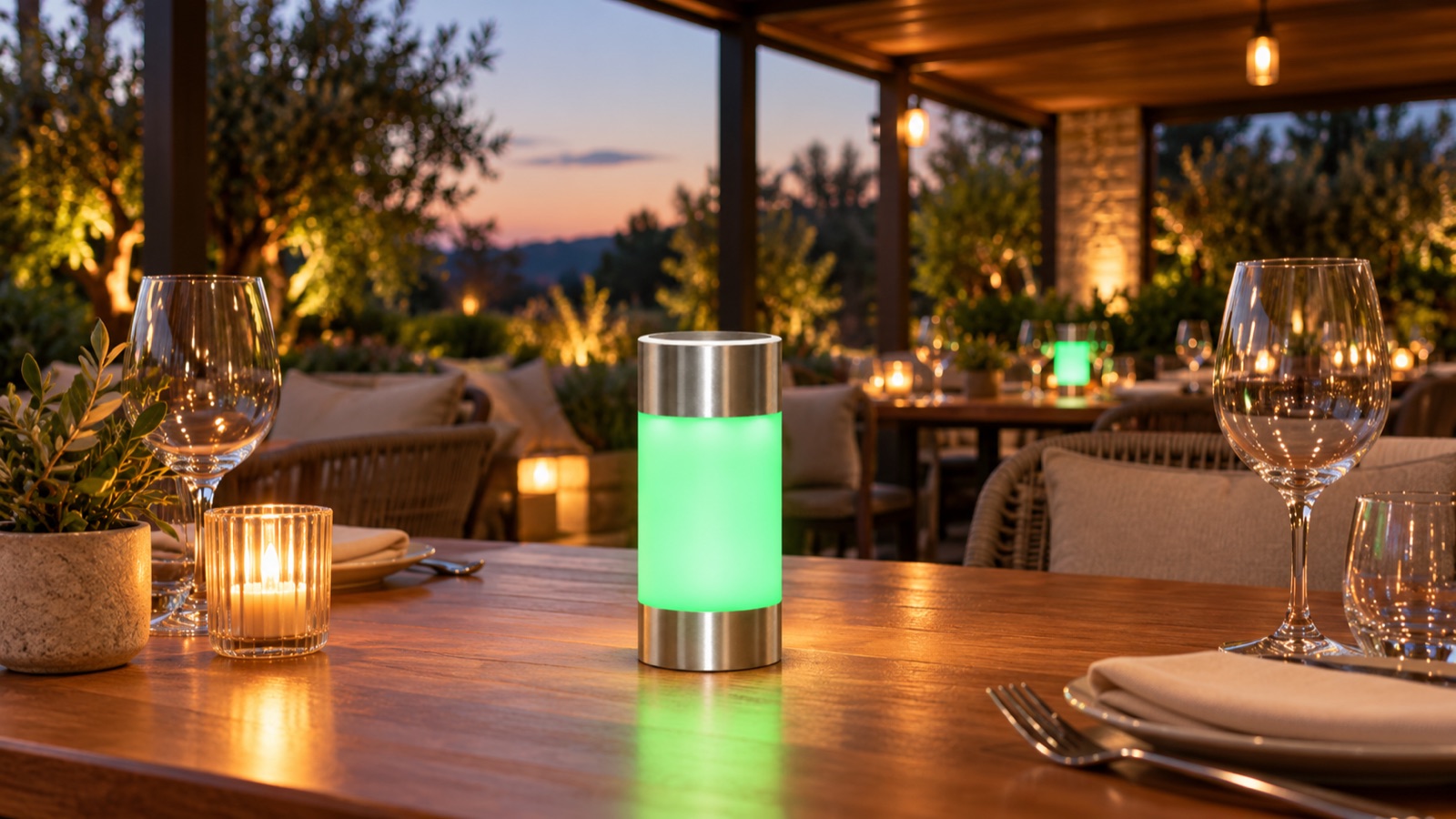
The JBTD-137 product page includes a covered-terrace scene, but the public specification reviewed for this guide does not state an IP rating or authorize wet-location use. That photo is an application illustration, not a water-resistance test. Buyers should confirm the model’s permitted environment, cleaning method, charging equipment and storage conditions before including it in an outdoor service plan.
Introduction: define what “covered patio” means at your venue
Hospitality buyers often search “rechargeable table lamps for covered patios” because they want flexible table lighting without adding a power point to every movable table. The practical question is narrower than “is the lamp outdoor?” A roof can reduce direct rainfall, but the perimeter, wind direction, furniture layout and closing routine determine what the product will actually encounter. A conservatory, a deep veranda and an open pergola can all be called a covered terrace while presenting very different moisture and cleaning conditions.
This guide turns that phrase into a procurement check. It helps restaurant groups, hotel operators, distributors and project suppliers map exposure, verify model evidence, run a cautious sample review and write an RFQ that separates the lamp from its charging accessories. It does not assign an outdoor rating to any Jbian model or interpret an unverified product as weather-resistant. The specific instructions supplied for the selected model and market control the decision.
Start with the exposure map, not the product photograph
Before requesting a quote, document the planned operating zones. The goal is not an engineering survey; it is a clear description the supplier can assess against its product documents. Mark where tables sit in relation to the roof edge, open sides, planters, service stations, doors and power outlets. Note whether the dining area is used only in dry weather or remains open when conditions change.
Record the conditions the lamp may encounter
For each zone, note likely sources of moisture and handling:
- Direct rain, wind-driven rain, condensation or only sheltered dry use.
- Drink spills, food splashes and the venue’s normal table-wiping products.
- Whether tables are moved under cover before closing or remain in place.
- Whether lamps are collected immediately after service or left outdoors overnight.
- Where lamps are charged and whether that area is dry, ventilated and protected from spills.
- Whether the venue is near the coast, a pool, a kitchen pass or another location with unusual exposure.
These observations prevent a vague label from hiding the operating facts. “Patio use” is not a test condition. “Under a fixed roof, two metres from the open edge, brought indoors after each service, cleaned with a specified damp cloth” is more useful because the supplier can compare it with documented limits and explain what remains uncertain.
Separate the operating zone from the charging zone
The lamp and the charging arrangement are separate items in the risk review. A light may be moved to a covered terrace while its charging base and power adapter stay indoors. Do not assume the accessories share the lamp’s enclosure protection, cleaning tolerance or permitted location. Ask for the instructions and ratings for each component that could be exposed.
Keep charging equipment in the environment specified by its manufacturer. Unless the documentation expressly permits it, do not charge a damp lamp, place a power adapter on an exposed counter, or run charging cables through a wet service route. Ask how the model should be dried, stored and returned to charging after outdoor use. If there is no written answer, that is a question to resolve before ordering rather than an operating detail to improvise after delivery.
Understand what an IP rating does and does not tell you
An IP code is a standardized way to classify protection provided by an electrical enclosure against access to hazardous parts, solid foreign objects and water under defined test conditions. IEC 60529 is the standard titled “Degrees of protection provided by enclosures (IP Code).” The code is useful only when it is associated with the exact equipment and the manufacturer’s stated conditions of use. It does not make every product carrying the same two digits suitable for every outdoor situation.
Ask the supplier to identify the exact model and component covered by a claimed rating, provide the supporting document or test reference, and state any conditions such as covers, orientation or closed ports. A rating for the lamp body should not automatically be applied to its charging dock, adapter, connector or storage case. Nor should a marketing phrase such as “splash proof” be treated as a substitute for a model-specific rating and instructions.
If no rating or outdoor instruction is available, do not fill the gap with an internet table that maps a number to a patio. Request written clarification. For a site with direct rain, frequent splashing, pressure washing or overnight exposure, ask a qualified lighting professional and the supplier whether the candidate is appropriate; if the answer is not documented, shortlist a product expressly rated for the actual use instead.
A four-step buyer review before approving terrace use
Step 1: send the supplier a location brief
Provide a short description and, if possible, a simple floor plan or annotated photo. Identify the roof type, open edges, service hours, likely wetting, cleaning products and where the lamps will be stored and charged. Avoid sending only a mood-board image. A beautiful photo communicates design direction but may omit the exposure that determines suitability.
Ask the supplier to answer each point as one of: documented as suitable, documented as not suitable, requires a specific operating control, or not confirmed. That structure keeps a sales discussion from turning into an implied warranty. For example, if the lamp can be used only under a stated dry condition, record that operating limit where supervisors and purchasing staff can find it.
Step 2: obtain the model-specific evidence
Request the current specification, operating instructions, cleaning instructions and any protection documentation for the exact model and revision being quoted. Confirm whether an outdoor or covered-terrace statement applies to the lamp only or to the complete system. Ask what happens if a lamp gets wet and which components must remain dry. Request written clarification if the public page and the supplied documents appear to say different things.
The JBTD-137 page describes a rechargeable flip lamp and a local green/red service signal, with 2600 mAh battery capacity and a specified charging configuration. Those facts do not establish resistance to rain or cleaning liquids. A correct buying guide keeps documented electrical specifications separate from environmental suitability rather than inferring one from the other.
Step 3: evaluate a sample in a permitted way
If the supplier confirms that the intended location is within the product’s stated use, review a sample under normal operating conditions. Assess stability on the actual table, guest sightlines, visibility under ambient lighting, staff movement, return handling and the practicality of the approved cleaning routine. Record the model, revision and accessories so results are not confused with a visually similar sample.
Do not simulate rain, spray, immersion, chemical cleaning or any other stress exposure unless the supplier’s test method and approval explicitly authorize it. A customer-created water test can damage equipment, create a safety hazard and still provide no valid evidence against a standard. If moisture resistance is essential, ask for test documentation from the responsible manufacturer or laboratory and confirm that the tested configuration matches the offered product.
Step 4: translate the outcome into a service rule
An accepted sample should lead to a short written instruction for staff: where the lamp may be placed, when it must be collected, how it may be wiped, what condition requires quarantine, and where charging occurs. Include a simple escalation step for a cracked diffuser, loose end ring, abnormal charging behavior or liquid ingress. Do not invent repair or battery-replacement procedures; use the manufacturer’s instructions.
During shipment inspection, check model identity, accessory completeness, visible condition and packaging against the approved order. Visual inspection does not prove an IP rating or reproduce a laboratory test. Keep the evidence boundary explicit: a carton check can confirm that the specified model arrived, while environmental suitability comes from the applicable documentation and any relevant testing.
Compare the proposed use with the evidence
| Proposed condition | Buyer question | Evidence to request | Conservative action if unknown |
|---|---|---|---|
| Dry indoor dining room | What cleaning method is allowed? | Model instructions and care guidance | Do not assume any liquid cleaner is permitted |
| Roofed terrace, sides partly open | Is wind-driven rain or humidity within the stated use? | Exact model environmental limits | Keep use dry and protected until confirmed |
| Drinks likely to spill near lamp | What happens after a spill, and may the surface be wiped? | Cleaning and incident instructions | Remove from service and seek supplier guidance |
| Open terrace or table left outside | Is direct rain and overnight exposure expressly allowed? | Model-specific rating and use statement | Do not place it outdoors based on a lifestyle image |
| Charging counter near wash area | Are dock, adapter and connectors suited to that location? | Separate accessory instructions and ratings | Relocate charging to a documented dry area |
This table is a question framework, not a substitute for the product manual. Local electrical requirements, venue risk assessments and the supplier’s instructions still apply.
Write the environmental conditions into the RFQ
When comparing quotations, give every supplier the same site description and ask them to respond in a comparable format. A concise RFQ can include:
- Product model, revision, quantity, finish and intended installation or placement zones.
- Whether the use is indoor, roofed outdoor, exposed outdoor or mixed.
- Distance from open edges, direct rain possibility and storage practice.
- Cleaning method and chemicals normally used on tables.
- Charging location, operating hours and who moves lamps between zones.
- Model-specific environmental rating, test evidence and instruction references.
- Exact charging base, adapter, plug option, cable and components in the quotation.
- Any limits, exclusions or operating controls the supplier requires.
- Sample approval method, labeling, packaging and shipment inspection scope.
Ask the supplier to mark unsupported requests “not confirmed” rather than answering with a broad “yes.” If two supplier quotations use different assumptions about exposure, they are not yet comparable. Resolve the open items before comparing unit prices or committing to a rollout.
Plan the operating workflow around the lamp’s stated limits
If a model is approved for a defined covered area, daily handling still matters. Set a collection point away from weather and cleaning spray. Make it clear which lamps are ready for service and which need inspection or charging. Keep the adapter and charging equipment where the product instructions permit. Assign responsibility for moving lamps indoors when weather changes; do not rely on a roof to control every condition at the open sides of a venue.
Cleaning is especially easy to mis-specify. “Wipeable” can mean a dry cloth, a damp cloth, or a particular cleaning agent and method. Confirm what is permitted for the diffuser, metal components, controls and charging contacts. Never submerge a table lamp or spray cleaner directly into openings unless the manufacturer explicitly instructs that method. Staff training should use the same written care guidance that purchasing reviewed.
For a mixed-use venue, consider separating inventory by zone. A lamp cleared for dry indoor use may be kept out of a terrace rotation if outdoor exposure has not been confirmed. Labeling and storage can prevent a busy team from moving a product into a use case that the buyer never approved. A zone-specific rule is more reliable than a generic sign saying “outdoor lamps.”
Common procurement mistakes to avoid
Treating “covered” as a technical rating. Roof coverage is a feature of the building, not an electrical test. Describe the sides, edges, splash sources and after-service storage.
Applying the lamp rating to the whole kit. A dock or adapter can have different limitations. Confirm the rating and instructions for every component exposed to the environment.
Testing water resistance informally. A home-made spray test does not establish a standardized protection class. It can damage a sample and create misleading confidence.
Assuming a photograph is a usage statement. A catalogue image can show a terrace without defining permissible moisture, charging or cleaning conditions. Get the model’s written instructions.
Ignoring the charging and storage route. The lamp may be used in one zone and charged in another. Document both locations, including transport between them.
Using an unverified cleaner. Surface appearance after one wipe does not establish chemical compatibility or repeated-cleaning durability. Ask for the care method and trial it only as instructed.
FAQs
Can I use any rechargeable table lamp under a roof?
No. A roof reduces some direct exposure but does not establish that the lamp can tolerate wind-driven rain, condensation, spills or cleaning products. Use it only when the exact model’s instructions cover the conditions at your venue.
Does a covered-terrace product photo prove an IP rating?
No. A scene photo shows an intended visual context, not a measured protection result. Ask for the model-specific rating and its supporting documentation.
Does an IP rating for the lamp also apply to its charging dock?
Not automatically. Confirm the documentation separately for the lamp, charging base, power adapter and connectors. Keep each component within its stated environment.
Can restaurant staff test a sample by spraying it with water?
Not unless the manufacturer has supplied and approved a suitable test procedure. An informal spray test does not establish conformity to IEC 60529 and could damage the product. Request the relevant test record instead.
What if the supplier does not provide an outdoor-use statement?
Treat the outdoor suitability as unconfirmed. Ask for written clarification and current documentation. If the answer remains unclear, limit the use to a documented environment or select a model expressly specified for the planned exposure.
Conclusion: buy against the actual environment
A covered restaurant patio is not a single technical condition. The roof, open sides, rain path, cleaning method, storage routine and charging location all shape the decision. Use a location brief, review evidence for the exact model and each accessory, evaluate a sample only within the permitted conditions, then write staff procedures around the confirmed limits.
JBTD-137’s published materials reviewed for this guide show a covered-terrace application image and list electrical and charging details; they do not establish an IP rating or authorize wet-location operation. That distinction is central to trustworthy procurement: use the product facts that are documented, ask about the conditions that are not, and do not let a lifestyle photo substitute for evidence.
Send your requirements to Jbian.
Contact Jbian with your venue exposure and product requirements. Include the intended terrace layout, cleaning routine, storage location and destination market so the team can identify which model-specific documents and questions should be resolved before sampling or quotation.